


Page 97 - (DK) Ocean - The Definitive Visual Guide
P. 97
COASTAL LANDSCAPES             95


                ATLANTIC OCEAN NORTHWEST                                                                HUMAN IMPACT
             Hatteras Island                                                                            CAPE HATTERAS
                                                                                                        LIGHTHOUSE
                           TYPE  Secondary coast
                           FORMATION  Deposition
                           of sediment by waves                                                         Erosion and deposition often
                           and currents                                                                 cause shorelines to migrate.
                           EXTENT  70 miles                                                             In 1999, the Cape Hatteras
                           (112 km)                                                                     Lighthouse was moved
             LOCATION  Off the coast of North Carolina,                                                 because the sea had
             northeastern US                                                                            begun to lap at its
                                                                                                        base, threatening
             Hatteras Island is a classic barrier                                                       its destruction.
             island of sandy composition. It runs
             parallel to the mainland and is long
             and narrow, with an average width of
             1,500 ft (450 m), and has been shaped
             by complex processes of deposition
             effected by ocean currents and waves.
             It is part of a series of barrier islands
             called the Outer Banks and has two
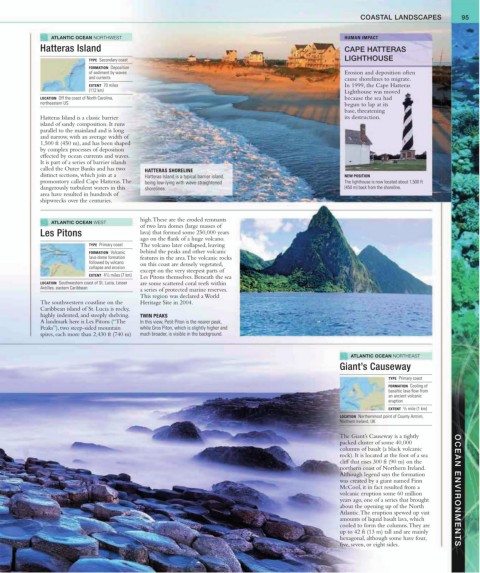
                                            HATTERAS SHORELINE
             distinct sections, which join at a   Hatteras Island is a typical barrier island,          NEW POSITION
             promontory called Cape Hatteras. The   being low-lying with wave-straightened              The lighthouse is now located about 1,500 ft
             dangerously turbulent waters in this   shorelines.                                         (450 m) back from the shoreline.
             area have resulted in hundreds of
             shipwrecks over the centuries.

                                           high. These are the eroded remnants
                ATLANTIC OCEAN WEST
                                           of two lava domes (large masses of
             Les Pitons                    lava) that formed some 250,000 years
                                           ago on the flank of a huge volcano.
                           TYPE  Primary coast  The volcano later collapsed, leaving
                           FORMATION  Volcanic   behind the peaks and other volcanic
                           lava-dome formation   features in the area. The volcanic rocks
                           followed by volcano   on this coast are densely vegetated,
                           collapse and erosion
                                           except on the very steepest parts of
                                1
                           EXTENT  4 / 2 miles (7 km)  Les Pitons themselves. Beneath the sea
             LOCATION  Southwestern coast of St. Lucia, Lesser   are some scattered coral reefs within
             Antilles, eastern Caribbean   a series of protected marine reserves.
                                           This region was declared a World
             The southwestern coastline on the   Heritage Site in 2004.
             Caribbean island of St. Lucia is rocky,
             highly indented, and steeply shelving.   TWIN PEAKS
             A landmark here is Les Pitons (“The   In this view, Petit Piton is the nearer peak,
             Peaks”), two steep-sided mountain   while Gros Piton, which is slightly higher and
             spires, each more than 2,430 ft (740 m)   much broader, is visible in the background.


                                                                                                         ATLANTIC OCEAN NORTHEAST
                                                                                                      Giant’s Causeway
                                                                                                                     TYPE  Primary coast
                                                                                                                     FORMATION  Cooling of
                                                                                                                     basaltic lava flow from
                                                                                                                     an ancient volcanic
                                                                                                                     eruption
                                                                                                                         3
                                                                                                                     EXTENT   / 5 mile (1 km)
                                                                                                      LOCATION  Northernmost point of County Antrim,
                                                                                                      Northern Ireland, UK
                                                                                                      The Giant’s Causeway is a tightly
                                                                                                      packed cluster of some 40,000
                                                                                                      columns of basalt (a black volcanic
                                                                                                      rock). It is located at the foot of a sea
                                                                                                      cliff that rises 300 ft (90 m) on the
                                                                                                      northern coast of Northern Ireland.
                                                                                                      Although legend says the formation
                                                                                                      was created by a giant named Finn
                                                                                                      McCool, it in fact resulted from a   OCEAN ENVIRONMENTS
                                                                                                      volcanic eruption some 60 million
                                                                                                      years ago, one of a series that brought
                                                                                                      about the opening up of the North
                                                                                                      Atlantic. The eruption spewed up vast
                                                                                                      amounts of liquid basalt lava, which
                                                                                                      cooled to form the columns. They are
                                                                                                      up to 42 ft (13 m) tall and are mainly
                                                                                                      hexagonal, although some have four,
                                                                                                      five, seven, or eight sides.

