


Page 15 - Amphibian
P. 15
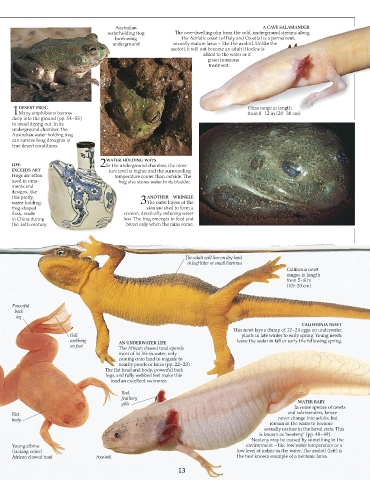
Australian                                       A CAVE SALAMANDER
                                     waterholding frog     The cave-dwelling olm from the cold, underground streams along
                                       burrowing             the Adriatic coast (of Italy and Croatia) is a permanent,
                                      underground         sexually mature larva – like the axolotl. Unlike the
                                                         axolotl, it will not become an adult if iodine is
                                                                    added to the water or if
                                                                      given hormone
                                                                      treatment.


       DESERT FROG                                                                 Olms range in length
     1Many amphibians burrow                                                       from 8–12 in (20–30 cm)
     deep into the ground (pp. 54–55)
     to avoid drying out. In its
     underground chamber, the
     Australian water-holding frog
     can survive long droughts in
     true desert conditions.
                                    WATER-HOLDING WAYS
     LIFE                         2In the underground chamber, the mois-
     EXCEEDS ART                     ture level is higher and the surrounding
     Frogs are often                   temperature cooler than outside. The
     used in orna-                      frog also stores water in its bladder.
     ments and
     designs, like
     this pretty,                                 ANOTHER  WRINKLE
     water-holding,                            3The outer layers of the
     frog-shaped                                  skin are shed to form a
     flask, made                          cocoon, drastically reducing water
     in China during                      loss. The frog emerges to feed and
     the 16th century.                     breed only when the rains come.


                                                              The adult will live on dry land
                                                               in leaf litter or small burrows
                                                                                                California newt
                                                                                                ranges in length
                                                                                                from 5–8 in
                                                                                                (13–20 cm)


     Powerful
      back
      leg
                                                                                                     CALIFORNIA NEWT
                                                                              This newt lays a clump of 12–24 eggs on underwater
                        Full                                                     plants in late winter to early spring. Young newts
                        webbing         AN UNDERWATER LIFE                     leave the water in fall or early the following spring.
                        on foot         The African clawed toad spends
                                        most of its life in water, only
                                        coming onto land to migrate to
                                        nearby ponds or lakes (pp. 22–23).
                                    The flat head and body, powerful back
                                    legs, and fully webbed feet make this
                                      toad an excellent swimmer.
                                         Red,
                                         feathery
                                         gills                                                      WATER BABY
                                                                                                  In some species of newts
     Flat                                                                                       and salamanders, larvae
     body                                                                                    never change into adults, but
                                                                                          remain in the water to become
                                                                                        sexually mature in the larval state. This
                                                                                       is known as “neoteny” (pp. 48–49).
                                                                                    Neoteny may be caused by something in the
     Young albino                                                                 environment – like low water temperature or a
     (lacking color)                                                           low level of iodine in the water. The axolotl (left) is
     African clawed toad         Axolotl                                       the best known example of a neotenic larva.
                                                            13

