


Page 16 - Amphibian
P. 16
Colors and markings


                                  Amphibians have an incredible range of colors and markings, from
                              bright blues, reds, and yellows to muddy browns and greens, with a variety
                            of stripes and spots. Many amphibians are darker on top, with a completely
                            different color and pattern on their belly. Like most animals, amphibians
                            either blend in with their surroundings for camouflage (pp. 20–21), or are
                            brightly colored to show predators that they are poisonous to eat (pp. 56–57).
                            An amphibian’s color may also help absorb or reflect heat, or attract a mate
          THE FROG PRINCE
           The story of the   (pp. 32–35). The main color and markings in an
         princess who kisses a
         frog, magically turning   amphibian’s skin are produced by three different
         him into a handsome   color pigment cells – white, yellow, and brown-
         prince, is a well-known
         fairy tale. In the 1815   black – which are found deep in the skin.
         version by the Brothers   There is no green or blue pigment – a frog
          Grimm, the princess
         dislikes the frog, but he   looks green when the blue part of white light is
        tricks her into caring for   absorbed by yellow cells. Brown-black pigment
           him, breaking the
          wicked witch’s spell.  cells can expand to darken, or contract to
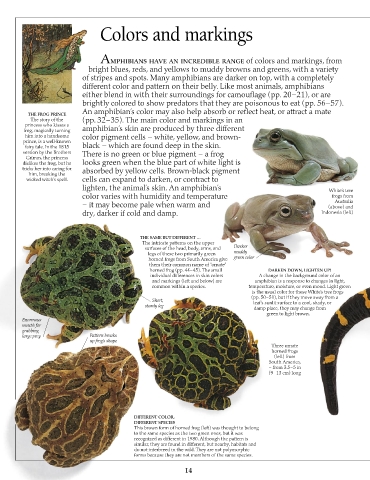
                            lighten, the animal’s skin. An amphibian’s                                        White’s tree
                            color varies with humidity and temperature                                         frogs from
                                                                                                                Australia
                            – it may become pale when warm and                                                (above) and
                            dry, darker if cold and damp.                                                  Indonesia (left)


                                               THE SAME BUT DIFFERENT …
                                                The intricate patterns on the upper
                                                 surfaces of the head, body, arms, and   Darker
                                                  legs of these two primarily green   muddy
                                                  horned frogs from South America give   green color
                                                  them their common name of “ornate”
                                                   horned frog (pp. 44–45). The small     DARKEN DOWN, LIGHTEN UP!
                                                   individual differences in skin colors   A change in the background color of an
                                                   and markings (left and below) are   amphibian is a response to changes in light,
                                                   common within a species.        temperature, moisture, or even mood. Light green
                                                                                    is the usual color for these White’s tree frogs
                                                                                    (pp. 50–51), but if they move away from a
                                                   Short,                            leaf’s sunlit surface to a cool, shady, or
                                                 sturdy leg
                                                                                     damp place, they may change from
                                                                                         green to light brown.
        Enormous
        mouth for
        grabbing
        large prey             Pattern breaks
                               up frog’s shape
                                                                                           Three ornate
                                                                                           horned frogs
                                                                                            (left) from
                                                                                          South America,
                                                                                          – from 3.5–5 in
                                                                                          (9–13 cm) long


                                             DIFFERENT COLOR,
                                             DIFFERENT SPECIES
                                             This brown form of horned frog (left) was thought to belong
                                             to the same species as the two green ones, but it was
                                             recognized as different in 1980. Although the pattern is
                                             similar, they are found in different, but nearby, habitats and
                                             do not interbreed in the wild. They are not polymorphic
                                             forms because they are not members of the same species.
                                                              14

