


Page 26 - Amphibian
P. 26
Leaps and bounds                                                                                SERIOUS FUN
                                                                                                        These children are
                                                                                                        having great fun
                                                                                                        playing leapfrog,
                                                                                                        but for real frogs
                                                                                                        leaping has a
        Think of frogs and you can imagine them effortlessly                                            serious purpose.
        leaping every which way. But not all frogs can leap –                                           They leap so they
                                                                                                        can capture their
        some walk, crawl, run, or hop short distances. Certain                                          food or escape
        tree frogs can even “fly,” or glide, from tree to tree                                          from danger.
        (pp. 50–51). Almost all tree frogs have sticky, sucker-
        like disks, or pads, on their hands and feet for clinging
        onto vegetation. The way frogs move is partly related to
        the length of their legs; short-legged frogs walk, crawl,                   Leg stretching to
        or make short hops; long-legged frogs leap or make                          full length
        extended hops. A frog’s behavior also affects the way it
        moves. It may walk slowly, stalking insects, or leap away
        in alarm from enemies. For any frog, the best method of
        escape is to make for the nearest cover, preferably by a
        quick leap into water. Their active lifestyle and the
        ability to take fast-moving prey have helped make
        frogs and toads the most successful group of
        modern amphibians, in terms of variety and                                                             Eye
                                                                                                               closing for
        numbers of species (pp. 42–45).                                                                        protection


                                                   Hump still visible


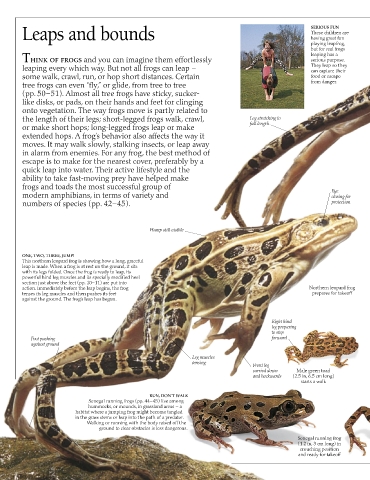
        ONE, TWO, THREE, JUMP!
        This northern leopard frog is showing how a long, graceful
        leap is made. When a frog is at rest on the ground, it sits
        with its legs folded. Once the frog is ready to leap, its
        powerful hind leg muscles and its specially modified heel
        section just above the feet (pp. 10–11) are put into
        action. Immediately before the leap begins, the frog                                           Northern leopard frog
        tenses its leg muscles and then pushes its feet                                                 prepares for takeoff
        against the ground. The frog’s leap has begun.


                                                                                           Right hind
                                                                                           leg preparing
                                                                                           to step
           Foot pushing                                                                    forward
           against ground

                                                                 Leg muscles
                                                                 tensing
                                                                                     Front leg
                                                                                     carried down   Male green toad
                                                                                     and backwards  (2.5 in, 6.5 cm long)
                                                                                                     starts a walk

                                                   RUN, DON’T WALK
                              Senegal running frogs (pp. 44–45) live among
                              hummocks, or mounds, in grassland areas – a
                          habitat where a jumping frog might become tangled
                          in the grass stems or leap into the path of a predator.
                              Walking or running with the body raised off the
                                  ground to clear obstacles is less dangerous.
                                                                                                    Senegal running frog
                                                                                                    (1.2 in, 3 cm long) in
                                                                                                    crouching position
                                                                                                    and ready for takeoff

