


Page 25 - Amphibian
P. 25
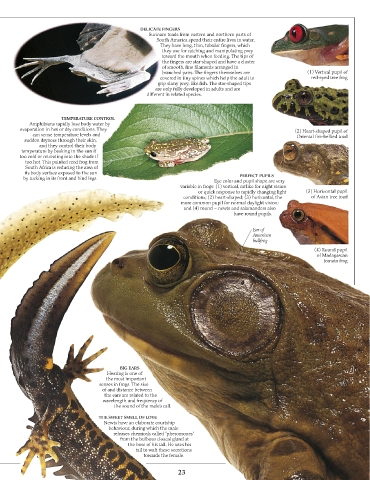
DELICATE FINGERS
                                                  Surinam toads from eastern and northern parts of
                                                     South America spend their entire lives in water.
                                                      They have long, thin, tubular fingers, which
                                                       they use for catching and manipulating prey
                                                       toward the mouth when feeding. The tips of
                                                       the fingers are star-shaped and have a cluster
                                                       of smooth, fine filaments arranged in
                                                       branched pairs. The fingers themselves are      (1) Vertical pupil of
                                                      covered in tiny spines which help the adult to    red-eyed tree frog
                                                     grip slimy prey, like fish. The star-shaped tips
                                                    are only fully developed in adults and are
                                                  different in related species.


                     TEMPERATURE CONTROL
           Amphibians rapidly lose body water by
        evaporation in hot or dry conditions. They                                                 (2) Heart-shaped pupil of
            can sense temperature levels and                                                       Oriental fire-bellied toad
         sudden dryness through their skin,
              and they control their body
        temperature by basking in the sun if
        too cold or retreating into the shade if
         too hot. This painted reed frog from
         South Africa is reducing the area of
         its body surface exposed to the sun
         by tucking in its front and hind legs.                                 PERFECT PUPILS
                                                                        Eye color and pupil shape are very
                                                             variable in frogs: (1) vertical, catlike for night vision
                                                                   or quick response to rapidly changing light   (3) Horizontal pupil
                                                              conditions; (2) heart-shaped; (3) horizontal, the   of Asian tree toad
                                                             more common pupil for normal daylight vision;
                                                              and (4) round – newts and salamanders also
                                                                              have round pupils.

                                                                                     Ear of
                                                                                     American
                                                                                     bullfrog
                                                                                                         (4) Round pupil
                                                                                                          of Madagascan
                                                                                                            tomato frog


                                         BIG EARS
                                    Hearing is one of

                                    the most important
                                  senses in frogs. The size
                                   of and distance between
                                    the ears are related to the
                                   wavelength and frequency of
                                       the sound of the male’s call.
                                  THE SWEET SMELL OF LOVE
                                   Newts have an elaborate courtship
                                     behaviour, during which the male
                                       releases chemicals called “pheromones”
                                         from the bulbous cloacal gland at
                                           the base of his tail. He uses his
                                              tail to waft these secretions
                                                 towards the female.

                                                            23

