


Page 56 - Complete Cat Care: How To Keep Your Cat Healthy and Happy
P. 56
Mouth and tooth disorders


            Cats use their mouths for eating and for grooming themselves. The
            mouth usually keeps itself healthy by producing saliva, but regular
            checks and even brushing the teeth will help prevent problems.


              Signs of a problem
              ■ Bad breath (halitosis)
              ■ Yellow or brown discoloration
              of teeth
              ■ White or yellow deposit
              (plaque) at base of teeth
              ■ Red gumline at base
              of teeth
     54       ■ Difficulty eating; possible
              avoidance of some foods
              ■ Loss of appetite
              ■ Crying in pain when trying
      Your cat’s health  ■ Drooling saliva, pus, or blood
              to eat, or pawing at mouth
              ■ Swelling on side of face
              ■ Gray discharge at gumline (pus)
              ■ Growth inside mouth or
              on jaws


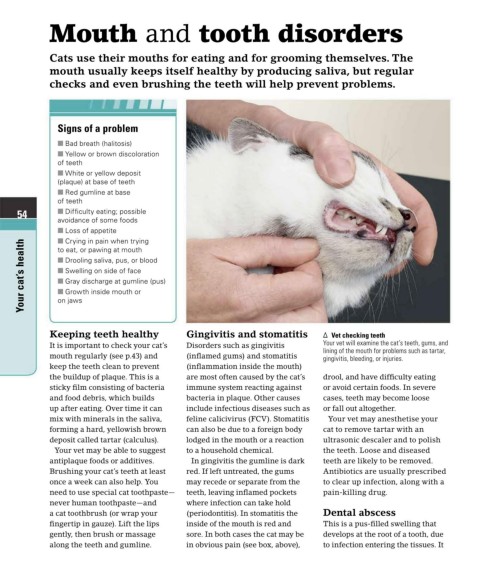
            Keeping teeth healthy           Gingivitis and stomatitis      △  Vet checking teeth
            It is important to check your cat’s   Disorders such as gingivitis   Your vet will examine the cat’s teeth, gums, and
                                                                           lining of the mouth for problems such as tartar,
            mouth regularly (see p.43) and   (inflamed gums) and stomatitis   gingivitis, bleeding, or injuries.
            keep the teeth clean to prevent    (inflammation inside the mouth)
            the buildup of plaque. This is a   are most often caused by the cat’s   drool, and have difficulty eating
            sticky film consisting of bacteria   immune system reacting against   or avoid certain foods. In severe
            and food debris, which builds    bacteria in plaque. Other causes   cases, teeth may become loose
            up after eating. Over time it can   include infectious diseases such as   or fall out altogether.
            mix with minerals in the saliva,   feline calicivirus (FCV). Stomatitis   Your vet may anesthetise your
            forming a hard, yellowish brown   can also be due to a foreign body   cat to remove tartar with an
            deposit called tartar (calculus).   lodged in the mouth or a reaction    ultrasonic descaler and to polish
             Your vet may be able to suggest   to a household chemical.    the teeth. Loose and diseased
            antiplaque foods or additives.   In gingivitis the gumline is dark   teeth are likely to be removed.
            Brushing your cat’s teeth at least   red. If left untreated, the gums    Antibiotics are usually prescribed
            once a week can also help. You    may recede or separate from the   to clear up infection, along with a
            need to use special cat toothpaste—  teeth, leaving inflamed pockets   pain-killing drug.
            never human toothpaste—and      where infection can take hold
            a cat toothbrush (or wrap your   (periodontitis). In stomatitis the   Dental abscess
            fingertip in gauze). Lift the lips   inside of the mouth is red and    This is a pus-filled swelling that
            gently, then brush or massage   sore. In both cases the cat may be    develops at the root of a tooth, due
            along the teeth and gumline.    in obvious pain (see box, above),   to infection entering the tissues. It


   US_054-055_Mouth_and_tooth_disorders.indd   54                                                    24/10/2013   15:06

