


Page 55 - Complete Cat Care: How To Keep Your Cat Healthy and Happy
P. 55
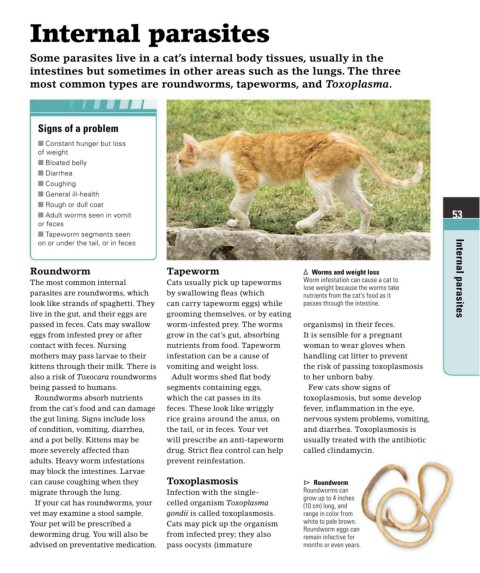
Internal parasites


        Some parasites live in a cat’s internal body tissues, usually in the
        intestines but sometimes in other areas such as the lungs. The three
        most common types are roundworms, tapeworms, and Toxoplasma.


          Signs of a problem
          ■ Constant hunger but loss
          of weight
          ■ Bloated belly
          ■ Diarrhea
          ■ Coughing
          ■ General ill-health
          ■ Rough or dull coat
          ■ Adult worms seen in vomit                                                                    53
          or feces
          ■ Tapeworm segments seen
          on or under the tail, or in feces


        Roundworm                      Tapeworm                        △  Worms and weight loss
        The most common internal       Cats usually pick up tapeworms    Worm infestation can cause a cat to    Internal parasites
        parasites are roundworms, which   by swallowing fleas (which    lose weight because the worms take
                                                                       nutrients from the cat’s food as it
        look like strands of spaghetti. They   can carry tapeworm eggs) while   passes through the intestine.
        live in the gut, and their eggs are   grooming themselves, or by eating
        passed in feces. Cats may swallow   worm-infested prey. The worms   organisms) in their feces.
        eggs from infested prey or after   grow in the cat’s gut, absorbing   It is sensible for a pregnant
        contact with feces. Nursing    nutrients from food. Tapeworm   woman to wear gloves when
        mothers may pass larvae to their   infestation can be a cause of   handling cat litter to prevent
        kittens through their milk. There is   vomiting and weight loss.   the risk of passing toxoplasmosis
        also a risk of Toxocara roundworms   Adult worms shed flat body   to her unborn baby.
        being passed to humans.        segments containing eggs,        Few cats show signs of
         Roundworms absorb nutrients   which the cat passes in its     toxoplasmosis, but some develop
        from the cat’s food and can damage   feces. These look like wriggly    fever, inflammation in the eye,
        the gut lining. Signs include loss    rice grains around the anus, on    nervous system problems, vomiting,
        of condition, vomiting, diarrhea,   the tail, or in feces. Your vet    and diarrhea. Toxoplasmosis is
        and a pot belly. Kittens may be   will prescribe an anti-tapeworm   usually treated with the antibiotic
        more severely affected than    drug. Strict flea control can help    called clindamycin.
        adults. Heavy worm infestations   prevent reinfestation.
        may block the intestines. Larvae
        can cause coughing when they   Toxoplasmosis                   ▷  Roundworm
        migrate through the lung.      Infection with the single-      Roundworms can
         If your cat has roundworms, your   celled organism Toxoplasma    grow up to 4 inches
                                                                       (10 cm) long, and
        vet may examine a stool sample.   gondii is called toxoplasmosis.    range in color from
        Your pet will be prescribed a   Cats may pick up the organism   white to pale brown.
                                                                       Roundworm eggs can
        deworming drug. You will also be   from infected prey; they also    remain infective for
        advised on preventative medication.   pass oocysts (immature   months or even years.


   US_052-053_Parasites.indd   53                                                                    24/10/2013   15:06

