


Page 60 - Complete Cat Care: How To Keep Your Cat Healthy and Happy
P. 60
Respiratory disorders


            The respiratory system extends from the nose and mouth to the lungs.
            Disorders can vary from common ailments such as sneezing and a runny
            nose to serious conditions that can interfere with your cat’s breathing.


              Signs of a problem
              ■ Nasal discharge from one or
              both nostrils: watery, white
              or green, or blood
              ■ Sneezing
              ■ Cough (fluid and “chesty”
              or dry and harsh)
              ■ Increased rate of breathing
     58       ■ Breathing with mouth
              open, panting
              ■ Noisy breathing or wheezing
              ■ Difficulty breathing—sitting
      Your cat’s health  ■ Anorexia, weight loss,
              hunched with neck stretched out
              dehydration
              ■ Lethargy

            Cat flu
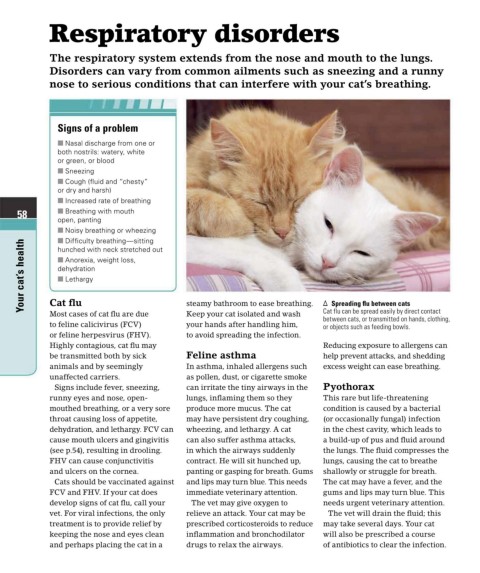
                                                                           Cat flu can be spread easily by direct contact
                                            Keep your cat isolated and wash
            Most cases of cat flu are due    steamy bathroom to ease breathing.   △  Spreading flu between cats
                                                                           between cats, or transmitted on hands, clothing,
            to feline calicivirus (FCV)     your hands after handling him,    or objects such as feeding bowls.
            or feline herpesvirus (FHV).    to avoid spreading the infection.
            Highly contagious, cat flu may                                 Reducing exposure to allergens can
            be transmitted both by sick     Feline asthma                  help prevent attacks, and shedding
            animals and by seemingly        In asthma, inhaled allergens such   excess weight can ease breathing.
            unaffected carriers.            as pollen, dust, or cigarette smoke
             Signs include fever, sneezing,   can irritate the tiny airways in the   Pyothorax
            runny eyes and nose, open-      lungs, inflaming them so they   This rare but life-threatening
            mouthed breathing, or a very sore   produce more mucus. The cat    condition is caused by a bacterial
            throat causing loss of appetite,   may have persistent dry coughing,   (or occasionally fungal) infection
            dehydration, and lethargy. FCV can   wheezing, and lethargy. A cat    in the chest cavity, which leads to
            cause mouth ulcers and gingivitis   can also suffer asthma attacks,    a build-up of pus and fluid around
            (see p.54), resulting in drooling.   in which the airways suddenly   the lungs. The fluid compresses the
            FHV can cause conjunctivitis    contract. He will sit hunched up,   lungs, causing the cat to breathe
            and ulcers on the cornea.       panting or gasping for breath. Gums   shallowly or struggle for breath.
             Cats should be vaccinated against   and lips may turn blue. This needs   The cat may have a fever, and the
            FCV and FHV. If your cat does   immediate veterinary attention.   gums and lips may turn blue. This
            develop signs of cat flu, call your    The vet may give oxygen to   needs urgent veterinary attention.
            vet. For viral infections, the only   relieve an attack. Your cat may be   The vet will drain the fluid; this
            treatment is to provide relief by   prescribed corticosteroids to reduce   may take several days. Your cat
            keeping the nose and eyes clean   inflammation and bronchodilator   will also be prescribed a course
            and perhaps placing the cat in a   drugs to relax the airways.   of antibiotics to clear the infection.


   US_058-059_Respiratory_and_circulatory_disorders.indd   58                                        24/10/2013   15:05

