


Page 62 - Complete Cat Care: How To Keep Your Cat Healthy and Happy
P. 62
Nervous system disorders


            The nervous system, comprising the brain, spinal cord, and nerves, carries
            electrical signals that control body functions and conscious activities. Injuries,
            genetic disorders, and infections are some of the main causes of problems.

                                            Recurrent seizures with no obvious
                                            cause are known as epilepsy.
              Signs of a problem            Seizures need prompt veterinary
                                            attention. A vet will carry out blood
              ■ Seizures                    tests and may advise radiography,
              ■ Disorientation              CT scans, or MRI scans of the brain.
              ■ Behavioral changes          Your cat will be treated for any
              ■ Head tilt                   underlying problem. If the cat
              ■ Poor balance                has epilepsy, he may need anti-
                                            epileptic drugs for life.      △  Movement problems in kittens
                                                                           Young kittens can be wobbly on their feet at first,
     60     Seizures and epilepsy           Inherited and                  but a kitten exposed to panleukopenia virus while
            In a seizure, abnormal electrical   congenital disorders       in the womb may move in a jerky, clumsy way.
            activity in the cat’s brain may cause
                                            Certain nervous system problems
                                                                           For example, if a pregnant cat
      Your cat’s health  jerking body and legs. A cat may   the gene that produces white fur   infectious enteritis), her kittens
            collapse, foaming at the mouth, and
                                            are genetic (see p.46). For example,
                                                                           catches panleukopenia (feline
                                            and blue eyes may also cause
            also show a violent, unprovoked
                                                                           may be born with brain damage that
                                                                           causes trembling and a jerky, wide-
                                            deafness. In Manx cats, the gene
            behavior change such as lashing
            out in rage. The most common
                                                                           legged walking gait. Cats are usually
                                            that causes them to be born tailless
            cause is poisoning (see pp.78–9).

                                            spinal cord. Some other disorders
            Other causes include head injury,   may also produce defects in the   vaccinated against panleukopenia.
            stroke, tumor, or infection.    are congenital (present from birth).   Vestibular syndrome
                                                                           The vestibular apparatus in the
                                                                           inner ear controls balance.
                                                                           Problems with this area, or the
                                                                           nerve connecting it to the brain,
                                                                           may cause a cat to fall over, totter
                                                                           in circles, or crouch when he walks.
                                                                           Other signs may include a head tilt,
                                                                           eyes flicking from side to side,
                                                                           nausea, and vomiting. In most
                                                                           cases no cause can be found, but
                                                                           sometimes the disorder results
                                                                           from an ear infection (see p.49)
                                                                           or, more rarely, a brain tumor or
                                                                           stroke. A vet may treat underlying
                                                                           problems and symptoms such as
                                                                           nausea, but usually the condition
                                                                           clears up by itself in a few days.
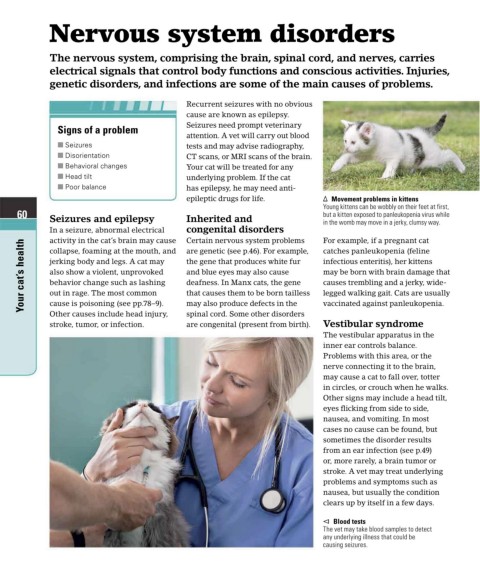
                                                                           ◁  Blood tests
                                                                           The vet may take blood samples to detect
                                                                           any underlying illness that could be
                                                                           causing seizures.


   US_060-061_Nerv_horm_disorders.indd   60                                                          24/10/2013   15:05

