


Page 157 - (DK) Home Doctor: Providing practical advice on home treatments
P. 157
FIRST AID  155

         Blisters


              Usually occurring on the feet and hands, blisters are caused by friction or pressure. First the skin
              becomes red and sore, then fluid collects under the surface in a pale, puffy skin sac. You may get
              blisters on your heel, sole, or toes from wearing boots or shoes that don’t fit well, or that have not been
              “broken in.” Blisters on the hands are often the result of heavy manual work. Most blisters heal quickly:
              as new skin grows beneath them, the fluid is reabsorbed and the surface dries and peels away.


              Seek medical advice
                                                                 PRACTICAL TECHNIQUE
              Arrange to see a doctor if:
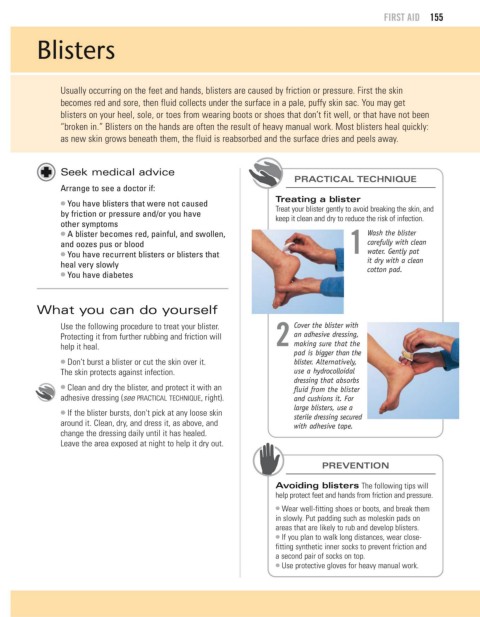
                                                            Treating a blister
              ● You have blisters that were not caused
                                                            Treat your blister gently to avoid breaking the skin, and
              by friction or pressure and/or you have       keep it clean and dry to reduce the risk of infection.
              other symptoms
              ● A blister becomes red, painful, and swollen,                    Wash the blister
              and oozes pus or blood                                            carefully with clean
              ● You have recurrent blisters or blisters that                1 water. Gently pat
                                                                                it dry with a clean
              heal very slowly
              ● You have diabetes                                               cotton pad.


         What you can do yourself

              Use the following procedure to treat your blister.  Cover the blister with
              Protecting it from further rubbing and friction will  an adhesive dressing,
              help it heal.                                 2 making sure that the
                                                                pad is bigger than the
              ● Don’t burst a blister or cut the skin over it.  blister. Alternatively,
              The skin protects against infection.              use a hydrocolloidal
                                                                dressing that absorbs
              ● Clean and dry the blister, and protect it with an  fluid from the blister
              adhesive dressing (see PRACTICAL TECHNIQUE, right).  and cushions it. For
                                                                large blisters, use a
              ● If the blister bursts, don't pick at any loose skin
                                                                sterile dressing secured
              around it. Clean, dry, and dress it, as above, and  with adhesive tape.
              change the dressing daily until it has healed.
              Leave the area exposed at night to help it dry out.
                                                                       PREVENTION

                                                            Avoiding blisters The following tips will
                                                            help protect feet and hands from friction and pressure.
                                                            ● Wear well-fitting shoes or boots, and break them
                                                            in slowly. Put padding such as moleskin pads on
                                                            areas that are likely to rub and develop blisters.
                                                            ● If you plan to walk long distances, wear close-
                                                            fitting synthetic inner socks to prevent friction and
                                                            a second pair of socks on top.
                                                            ● Use protective gloves for heavy manual work.

