


Page 158 - (DK) Home Doctor: Providing practical advice on home treatments
P. 158
156 FIRST AID

         Cuts, scrapes, and splinters


              Small cuts, scrapes, and splinters are common injuries. Cuts usually bleed for a short time. Scrapes bleed
              less, but may be painful and have dust and dirt trapped in them. You can often see or feel splinters in your
              skin or under nails, or you may not notice them until the area becomes red, hot, and painful due to infection.
              These injuries, though minor, can carry the risk of tetanus, a serious bacterial infection that can be fatal.
              People are normally immunized against it in childhood but may need boosters as adults. After treating
              any injury that breaks the skin, check that tetanus immunization is up to date. Seek medical advice
              if it is more than 10 years since immunization or if you are not sure when the last injection was given.


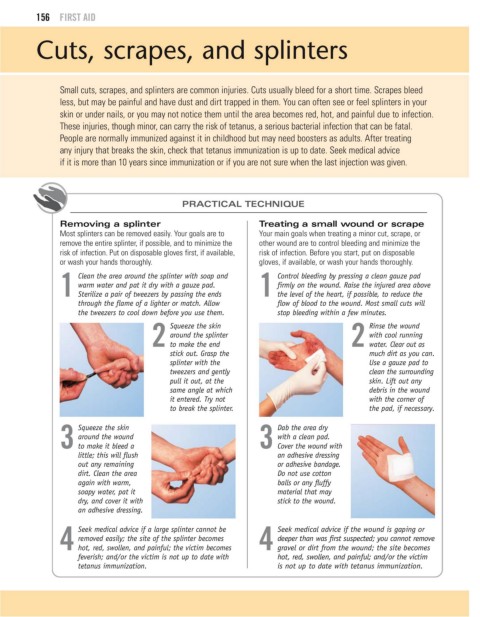
                                        PRACTICAL TECHNIQUE

              Removing a splinter                        Treating a small wound or scrape
              Most splinters can be removed easily. Your goals are to  Your main goals when treating a minor cut, scrape, or
              remove the entire splinter, if possible, and to minimize the  other wound are to control bleeding and minimize the
              risk of infection. Put on disposable gloves first, if available,  risk of infection. Before you start, put on disposable
              or wash your hands thoroughly.             gloves, if available, or wash your hands thoroughly.
                  Clean the area around the splinter with soap and  Control bleeding by pressing a clean gauze pad
                  warm water and pat it dry with a gauze pad.  firmly on the wound. Raise the injured area above
              1 Sterilize a pair of tweezers by passing the ends  1 the level of the heart, if possible, to reduce the
                  through the flame of a lighter or match. Allow   flow of blood to the wound. Most small cuts will
                  the tweezers to cool down before you use them.  stop bleeding within a few minutes.
                                      Squeeze the skin                           Rinse the wound
                                      around the splinter                        with cool running
                                  2 to make the end                          2 water. Clear out as
                                      stick out. Grasp the                       much dirt as you can.
                                      splinter with the                          Use a gauze pad to
                                      tweezers and gently                        clean the surrounding
                                      pull it out, at the                        skin. Lift out any
                                      same angle at which                        debris in the wound
                                      it entered. Try not                        with the corner of
                                      to break the splinter.                     the pad, if necessary.
                  Squeeze the skin                           Dab the area dry
                  around the wound                           with a clean pad.
              3 to make it bleed a                       3 Cover the wound with
                  little; this will flush                    an adhesive dressing
                  out any remaining                          or adhesive bandage.
                  dirt. Clean the area                       Do not use cotton
                  again with warm,                           balls or any fluffy
                  soapy water, pat it                        material that may
                  dry, and cover it with                     stick to the wound.
                  an adhesive dressing.

                  Seek medical advice if a large splinter cannot be  Seek medical advice if the wound is gaping or
                  removed easily; the site of the splinter becomes  deeper than was first suspected; you cannot remove
              4 hot, red, swollen, and painful; the victim becomes 4 gravel or dirt from the wound; the site becomes
                  feverish; and/or the victim is not up to date with  hot, red, swollen, and painful; and/or the victim
                  tetanus immunization.                      is not up to date with tetanus immunization.

