


Page 156 - (DK) Home Doctor: Providing practical advice on home treatments
P. 156
154 FIRST AID

         First-aid essentials


              To give first aid effectively, it is important to be well prepared.
                                                                            WARNING
              The step-by-step plan given below can be applied to any
              emergency to help you deal with a victim. Cross-references take  If you cannot approach a victim
                                                                     without putting yourself in danger,
              you to the specific first-aid techniques you may need on other
                                                                     dial 911 or call emergency medical
              pages. Access to first-aid materials can make all the difference  services (EMS) immediately.
              in an emergency, so an essential kit is described here.


         Emergency action plan
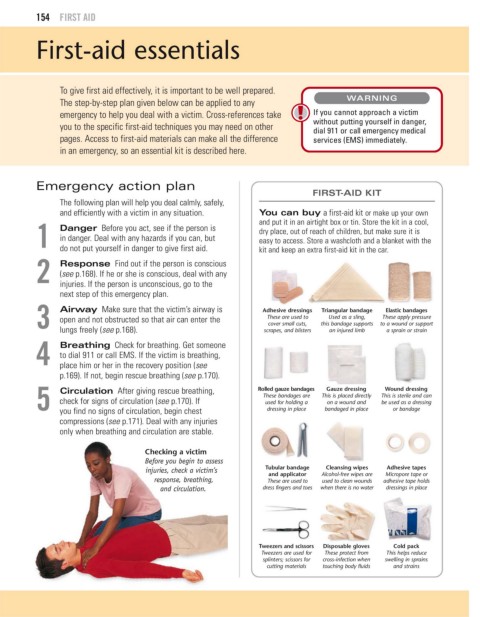
                                                                    FIRST-AID KIT
              The following plan will help you deal calmly, safely,
              and efficiently with a victim in any situation.   You can buy a first-aid kit or make up your own
                                                         and put it in an airtight box or tin. Store the kit in a cool,
              Danger Before you act, see if the person is
         1    in danger. Deal with any hazards if you can, but   dry place, out of reach of children, but make sure it is
                                                         easy to access. Store a washcloth and a blanket with the
              do not put yourself in danger to give first aid.  kit and keep an extra first-aid kit in the car.
         2    Response Find out if the person is conscious
              (see p.168). If he or she is conscious, deal with any
              injuries. If the person is unconscious, go to the
              next step of this emergency plan.
         3    Airway Make sure that the victim’s airway is  Adhesive dressings  this bandage supports  to a wound or support
                                                                      Triangular bandage
                                                                                    Elastic bandages
                                                                        Used as a sling,
                                                                                    These apply pressure
                                                           These are used to
              open and not obstructed so that air can enter the
                                                           cover small cuts,
              lungs freely (see p.168).                   scrapes, and blisters  an injured limb  a sprain or strain
         4    Breathing Check for breathing. Get someone
              to dial 911 or call EMS. If the victim is breathing,
              place him or her in the recovery position (see
              p.169). If not, begin rescue breathing (see p.170).
                                                                       Gauze dressing
                                                                                    Wound dressing
         5    Circulation After giving rescue breathing,   Rolled gauze bandages  This is placed directly  This is sterile and can
                                                          These bandages are
              check for signs of circulation (see p.170). If
                                                                        on a wound and
                                                                                   be used as a dressing
                                                          used for holding a
              you find no signs of circulation, begin chest  dressing in place   bandaged in place  or bandage
              compressions (see p.171). Deal with any injuries
              only when breathing and circulation are stable.
                                Checking a victim
                                Before you begin to assess
                                                          Tubular bandage   Cleansing wipes  Adhesive tapes
                                injuries, check a victim’s
                                                           and applicator  Alcohol-free wipes are  Micropore tape or
                                  response, breathing,     These are used to   used to clean wounds  adhesive tape holds
                                    and circulation.      dress fingers and toes   when there is no water  dressings in place
                                                         Tweezers and scissors  Disposable gloves  Cold pack
                                                         Tweezers are used for  These protect from  This helps reduce
                                                          splinters; scissors for  cross-infection when  swelling in sprains
                                                           cutting materials  touching body fluids  and strains

