


Page 110 - (DK Eyewitness) Travel Guide - Rome
P. 110
108 ROME AREA B Y AREA
1 Temple of
Hadrian
La Borsa, Piazza di Pietra. Map 4 F3 &
12 E2. @ 117, 119, 492, and routes
along Via del Corso or stopping at
Piazza S. Silvestro. Open for exhibitions.
This temple honors the emperor
Hadrian as a god, and was
dedicated by his son, and
successor, Antoninus Pius in
AD 145. The remains of the
temple are visible on the
southern side of Piazza di Pietra,
incorporated into a 17th-century
building. This was originally
a papal customs house,
completed by Carlo Fontana
and his son in the 1690s. Today
the building houses the Roman
stock exchange (La Borsa).
Eleven marble Corinthian
columns 49 ft (15 m) high stand
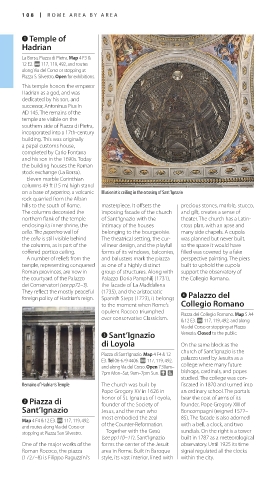
on a base of peperino, a volcanic Illusionistic ceiling in the crossing of Sant’Ignazio
rock quarried from the Alban
hills to the south of Rome. masterpiece. It offsets the precious stones, marble, stucco,
The columns decorated the imposing facade of the church and gilt, creates a sense of
northern flank of the temple of Sant’Ignazio with the theater. The church has a Latin-
enclosing its inner shrine, the intimacy of the houses cross plan, with an apse and
cella. The peperino wall of belonging to the bourgeoisie. many side chapels. A cupola
the cella is still visible behind The theatrical setting, the cur- was planned but never built,
the columns, as is part of the vilinear design, and the playful so the space it would have
coffered portico ceiling. forms of its windows, balconies, filled was covered by a fake
A number of reliefs from the and balusters mark the piazza perspective painting. The piers
temple, representing conquered as one of a highly distinct built to uphold the cupola
Roman provinces, are now in group of structures. Along with support the observatory of
the courtyard of the Palazzo Palazzo Doria Pamphilj (1731), the Collegio Romano.
dei Conservatori (see pp72–3). the facade of La Maddalena
They reflect the mostly peaceful (1735), and the aristocratic 4 Palazzo del
foreign policy of Hadrian’s reign. Spanish Steps (1723), it belongs
to the moment when Rome’s Collegio Romano
opulent Rococo triumphed Piazza del Collegio Romano. Map 5 A4
over conservative Classicism. & 12 E3. @ 117, 119, 492, and along
Via del Corso or stopping at Piazza
3 Sant’Ignazio Venezia. Closed to the public.
di Loyola On the same block as the
church of Sant’Ignazio is the
Piazza di Sant’Ignazio. Map 4 F4 & 12
E3. Tel 06-679 4406. @ 117, 119, 492, palazzo used by Jesuits as a
and along Via del Corso. Open 7:30am– college where many future
7pm Mon–Sat, 9am–7pm Sun. 5 7 bishops, cardinals, and popes
studied. The college was con-
Remains of Hadrian’s Temple The church was built by fiscated in 1870 and turned into
Pope Gregory XV in 1626 in an ordinary school. The portals
2 Piazza di honor of St. Ignatius of Loyola, bear the coat of arms of its
founder of the Society of
founder, Pope Gregory XIII of
Sant’Ignazio Jesus, and the man who Boncompagni (reigned 1572–
most embodied the zeal 85). The facade is also adorned
Map 4 F4 & 12 E3. @ 117, 119, 492,
and routes along Via del Corso or of the Counter-Reformation. with a bell, a clock, and two
stopping at Piazza San Silvestro. Together with the Gesù sundials. On the right is a tower
(see pp110–11), Sant’Ignazio built in 1787 as a meteorological
One of the major works of the forms the center of the Jesuit observatory. Until 1925 its time
Roman Rococo, the piazza area in Rome. Built in Baroque signal regulated all the clocks
(1727–8) is Filippo Raguzzini’s style, its vast interior, lined with within the city.
US_108-109_EW_Rome_US.indd 108 15/03/17 4:19 pm

