


Page 57 - All About History - Issue 56-17
P. 57
Suleiman the Magnificent

                                                         Henry VIII


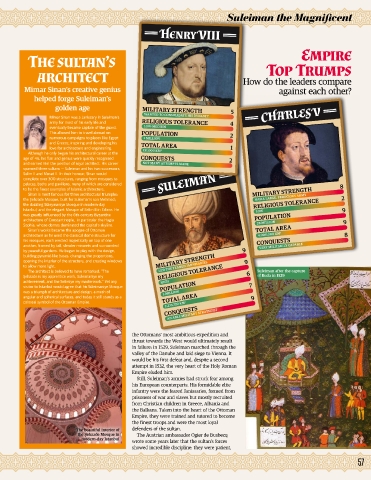
           The sultan’s                                                                                    Empire
                                                                                               Top  Trumps
              architect                                                               How do the leaders compare


          Mimar Sinan’s creative genius                                                            against each other?
             helped forge Suleiman’s
                    golden age
                                                   Military strength
                                                                                  5          CHARLES V
                                                    wanted to consolidate his dynasty
                  Mimar Sinan was a Janissary in Suleiman’s
                  army for most of his early life and   religious tolerance       4
                  eventually became captain of the guard.   low-MediuM
                  This allowed him to travel abroad on   PoPulation
                  numerous campaigns to places like Egypt   3 Million             2
                  and Greece, inspiring and developing his
                  love for architecture and engineering.  total area              1
                                                   151.000 KM 2
           Although he only began his architectural career at the
         age of 46, his flair and genius were quickly recognised   conquests
         and earned him the position of royal architect. His career   not Many atteMPts Made  2
         spanned three sultans — Suleiman and his two successors,
         Selim II and Murad II. In their honour, Sinan would
         complete over 300 structures, ranging from mosques to
         palaces, baths and pavilions, many of which are considered   SULEIMAN
         to be the finest examples of Islamic architecture.                                                              8
           Sinan is most famous for three architectural triumphs:                         Military strength
         the Şehzade Mosque, built for Suleiman’s son Mehmed;                              had a large, ferocious arMy   2
         the dazzling Süleymaniye Mosque in modern-day                                    religious tolerance
         Istanbul; and the elegant Mosque of Selim II in Edirne. He                        low                           9
         was greatly influenced by the 6th-century Byzantine                              PoPulation
         architecture of Constantinople,  in particular the Hagia
         Sophia, whose domes dominated the capital’s skyline.                              28 Million                     9
           Sinan’s works became the apogee of Ottoman                                      total area
         architecture as he used the classical dome structure for                           4,000,000 KM 2                8
         his mosques, each erected majestically on top of one                              conquests
         another, framed by tall, slender minarets and surrounded                           very Militarily caPable
         by peaceful gardens. He began to play with the design,                       9
         building pyramid-like bases, changing the proportions,
         opening the interior of the structure, and creating windows   Military strength  9
         to allow more light.                            led the feared Jannisaries
           The architect is believed to have remarked, “The   religious tolerance          Suleiman after the capture
         Şehzade is my apprentice work, Süleimaniye my                                  6  of Buda in 1529
         achievement, and the Selimiye my masterwork.” Yet any   high
         visitor to Istanbul would agree that his Süleimaniye Mosque   PoPulation        7
         was a triumph of architecture and design, a mesh of   5 Million
         angular and spherical surfaces, and today it still stands as a   total area     9
         colossal symbol of the Ottoman Empire.            2,273,720 kM 2
                                                           conquests
                                                            an able Military strategist


                                               the Ottomans’ most ambitious expedition and
                                               thrust towards the West would ultimately result
                                               in failure: in 1529, Suleiman marched through the
                                               valley of the Danube and laid siege to Vienna. It
                                               would be his first defeat and, despite a second
                                               attempt in 1532, the very heart of the Holy Roman
                                               Empire eluded him.
                                                 Still, Suleiman’s armies had struck fear among
                                               his European counterparts. His formidable elite
                                               infantry were the feared Janissaries, formed from
                                               prisoners of war and slaves but mostly recruited
                                               from Christian children in Greece, Albania and
                                               the Balkans. Taken into the heart of the Ottoman
                                               Empire, they were trained and tutored to become
                                               the finest troops and were the most loyal
                            The beautiful interior of   defenders of the sultan.
                            the Şehzade Mosque in   The Austrian ambassador Ogier de Busbecq
                              modern-day Istanbul
                                               wrote some years later that the sultan’s forces
                                               showed incredible discipline: they were patient,
                                                                                                                               57

