


Page 55 - All About History - Issue 56-17
P. 55
Suleiman the Magnificent


                  t the beginning of the 16th century,   Suleiman’s father, Selim I (also known as Selim
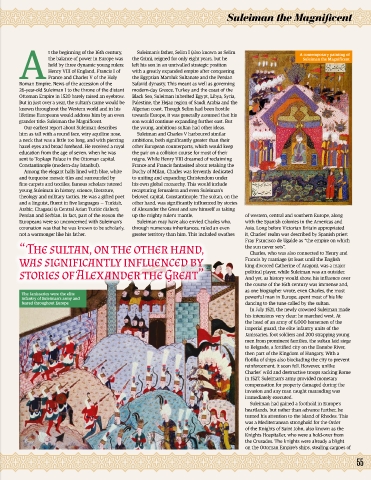
                                                                                                          A contemporary painting of
                  the balance of power in Europe was   the Grim), reigned for only eight years, but he     Suleiman the Magnificent
                  held by three dynamic young rulers:    left his son in an unrivalled strategic position
                  Henry VIII of England, Francis I of   with a greatly expanded empire after conquering
        A  France and Charles V of the Holy    the Egyptian Mamluk Sultanate and the Persian
        Roman Empire. News of the accession of the   Safavid dynasty. This meant as well as governing
        26-year-old Suleiman I to the throne of the distant   modern-day Greece, Turkey and the coast of the
        Ottoman Empire in 1520 barely raised an eyebrow.   Black Sea, Suleiman inherited Egypt, Libya, Syria,
        But in just over a year, the sultan’s name would be   Palestine, the Hejaz region of Saudi Arabia and the
        known throughout the Western world and in his   Algerian coast. Though Selim had been hostile
        lifetime Europeans would address him by an even   towards Europe, it was generally assumed that his
        grander title: Suleiman the Magnificent.  son would continue expanding further east. But
          Our earliest report about Suleiman describes   the young, ambitious sultan had other ideas.
        him as tall with a round face, wiry aquiline nose,   Suleiman and Charles V harboured similar
        a neck that was a little too long, and with piercing   ambitions, both significantly greater than their
        hazel eyes and broad forehead. He received a royal   other European counterparts, which would keep
        education from the age of seven, when he was   the pair on a collision course for most of their
        sent to Topkapı Palace in the Ottoman capital,   reigns. While Henry VIII dreamed of reclaiming
        Constantinople (modern-day Istanbul).  France and Francis fantasised about retaking the
          Among the elegant halls lined with blue, white   Duchy of Milan, Charles was fervently dedicated
        and turquoise mosaic tiles and surrounded by   to uniting and expanding Christendom under
        fine carpets and textiles, famous scholars tutored   his own global monarchy. This would include
        young Suleiman in history, science, literature,   recapturing Jerusalem and even Suleiman’s
        theology and military tactics. He was a gifted poet   beloved capital, Constantinople. The sultan, on the
        and a linguist, fluent in five languages — Turkish,   other hand, was significantly influenced by stories
        Arabic, Chagatai (a Central Asian Turkic dialect),   of Alexander the Great and saw himself as taking
        Persian and Serbian. In fact, part of the reason the   up the mighty ruler’s mantle.  of western, central and southern Europe, along
        Europeans were so unconcerned with Suleiman’s   Suleiman may have also envied Charles who,   with the Spanish colonies in the Americas and
        coronation was that he was known to be scholarly,   through numerous inheritances, ruled an even   Asia. Long before Victorian Britain appropriated
        not a warmonger like his father.       greater territory than him. This included swathes   it, Charles’ realm was described by Spanish priest
                                                                                       Fray Francisco de Ugalde as “the empire on which
        “ The sultan, on the other hand,                                               the sun never sets”.
                                                                                         Charles, who was also connected to Henry and
        was significantly influenced by                                                Francis by marriage (at least until the English
                                                                                       king divorced Catherine of Aragon), was a major
        stories of Alexander the Great”                                                political player, while Suleiman was an outsider.
                                                                                       And yet, as history would show, his influence over
                                                                                       the course of the 16th century was immense and,
                                                                                       as one biographer wrote, even Charles, the most
         The Janissaries were the elite
         infantry of Suleiman’s army and                                               powerful man in Europe, spent most of his life
         feared throughout Europe                                                      dancing to the tune called by the sultan.
                                                                                         In July 1521, the newly crowned Suleiman made
                                                                                       his intensions very clear: he marched west. At
                                                                                       the head of an army of 6,000 horsemen of the
                                                                                       imperial guard, the elite infantry units of the
                                                                                       Janissaries, foot soldiers and 200 strapping young
                                                                                       men from prominent families, the sultan laid siege
                                                                                       to Belgrade, a fortified city on the Danube River,
                                                                                       then part of the Kingdom of Hungary. With a
                                                                                       flotilla of ships also blockading the city to prevent
                                                                                       reinforcement, it soon fell. However, unlike
                                                                                       Charles’ wild and destructive troops sacking Rome
                                                                                       in 1527, Suleiman’s army provided monetary
                                                                                       compensation for property damaged during the
                                                                                       invasion and any man caught marauding was
                                                                                       immediately executed.
                                                                                         Suleiman had gained a foothold in Europe’s
                                                                                       heartlands, but rather than advance further, he
                                                                                       turned his attention to the island of Rhodes. This
                                                                                       was a Mediterranean stronghold for the Order
                                                                                       of the Knights of Saint John, also known as the
                                                                                       Knights Hospitaller, who were a hold-over from
                                                                                       the Crusades. The knights were already a blight
                                                                                       on the Ottoman Empire’s ships, stealing cargoes of
                                                                                                                              55

