


Page 58 - All About History - Issue 56-17
P. 58
Suleiman the Magnificent


        obedient, never prone to brawling and, above   and drank wine from a goblet made from a single  The empire
                                                 He dined on a silver table using silver plates
        all, fearless. They abstained from alcohol and
        lived on a diet of turnips, cucumber, garlic, salt   piece of turquoise. With over 50 courses served
        and vinegar. They only drank water, which they   by 200 attendants wearing red silk and gold-  of Suleiman
        mixed, once or twice a day, with flour, a small bit   embroidered hats, the sultan and his court
        of butter, powdered beef and spices — perhaps   would eat in halls filled with thick carpets and
        the Ottoman Empire’s answer to the modern day   cloths of gold. His tables were laden with an
        protein shake. Busbecq concluded,           array of seafood from the Bosphorus:
        “I dread to think what the future holds        lobster, sturgeon, muscles, swordfish.
        for us when I compare the Turkish                Henry VIII may have a reputation
        system to ours.”                                  for indulgence, even gluttony, but
          But ambassadors wrote to                        his feasts paled in comparison
        their monarchs of more than the                    to  Suleiman’s.                                     07
        Ottomans’ military might. The                       The beauty of Turkish
        details of the Ottoman court itself,              dress and carpets captured
        described in vivid detail in the                  the attention and imagination
        reports of Holy Roman, French and                of Europe. From the Doge’s
        Venetian ambassadors, reveal a world           Palace in Venice — through which
        of grandeur, opulence and refinement.       Ottoman art, textiles and culture flowed
        Soon, Ottoman dress, art and culture permeated   — to Hampton Court, plush, vibrant textiles
        Europe, becoming some of the most highly prized   and carpets were a symbol of wealth and
        elements of the period. Throughout Suleiman’s   sophistication. Henry VIII himself, on several
        reign there was enormous admiration for this   occasions, even participated in court masques
        inventive, intelligent monarch. Suleiman had once   dressed as a Turk.
        been called the ‘Scourge of Heaven’ — now he was   In 1532, Venetian merchants sold Suleiman
        known as ‘the Magnificent’.            a gold throne studded with jewels and pearls,
          Suleiman wore elaborate floor-length caftans   estimated to cost 40,000 ducats. He sat in
        made of satins and silks, often lined with sable   his great hall on his ornate throne receiving
        and patterned in ways that made even the most   gifts: cotton from Egypt, damask from Syria;
        extravagant of European monarchs look drab and   from Mosul, silver plates, cloth of gold and
        pedestrian. He was also partial to shirts made of   lapis lazuli. Suleiman was particularly fond
        soft white linen, lined with white cotton faced   of Chinese porcelain and he imported furs
        with rose-coloured silk, all perfumed with aloe   and Arabian horses. Even on campaigns, the
        wood, and the sultan never wore the same    sultan made an impression.
        clothes twice.                           Contemporary descriptions of his triumphal
                                               march to Vienna in 1532 describe foot soldiers
                                               and cavalry troops followed by standard-
                                               bearers carrying flags with Ottoman crescents
                                               and the prophet Muhammad’s name
                                               embroidered in pearls and jewels. 12 pages
                                               followed, carrying costly helmets glittering
                                               with gemstones. One of the most famous
                                               ones was a golden helmet of four crowns, all
                                               with enormous 12-carat pearls, diamonds,
                                               rubies and a large turquoise stone. It was
                                               a triumph of Venetian craftsmanship and,
                                               rather curiously, bore a striking resemblance
                                               to the papal tiara.
                                                 Suleiman rode on a magnificent horse, the
                                               saddle of which was estimated to be worth
                                               70,000 ducats, while its chamfron — the
                                               plate designed to protect the horse’s face —
                                               boasted a piece of turquoise as large as an
                                               egg. The sultan wore a large turban and a
                                               fur-lined gold brocade caftan of royal purple
                                               embroidered with jewels. Around his neck,
                                               he wore a gold chain that was so heavy it
                                               required attendants to ride on both sides to
                                               relieve the weight.                        7. The Crescent and the Lily
                                                 But Suleiman himself earned the          The alliance between France and the
                                               admiration of visitors to his court. Ambassador   Ottoman Empire shocked the rest of
                                               Busbecq was impressed by his wise approach    Christian Europe to its very core. This
                                                                                          important foreign alliance was maintained
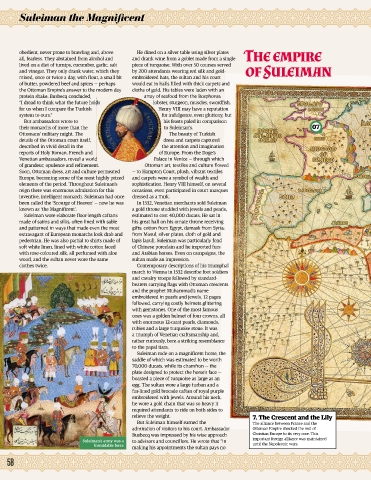
                              Suleiman’s army was a   to advisors and councillors. He wrote that “in
                                  formidable force                                        until the Napoleonic wars.
                                               making his appointments the sultan pays no
    58

