


Page 60 - All About History - Issue 56-17
P. 60
Suleiman the Magnificent


              Roxelana:


          The Ottoman

          Anne Boleyn


              Roxelana’s astonishing
           success at Suleiman’s court
            was attributed not only to
            her beauty but also to her
            intelligence and ambition
         A young woman appeared at Suleiman’s court in
         1523, captured by Turkish raiders in Galatia. It is believed
         that she was originally from Ruthenia, in present-day
         Ukraine, and so she was given the nickname ‘Roxelana’,
         meaning ‘the Russian’ or the ‘Ruthenian One’. She was fair
         with long red hair and, while in the sultan’s harem, her
         beauty, bright, witty nature and sharp intelligence caught
         the sultan’s eye and she soon became a favourite. But this
         was only the beginning.
           Suleiman made the unprecedented move of forsaking
         all other women in his harem and became devoted only
         to Roxelana. It was rumoured that she ensured things
         would stay that way by burning the harem down so that
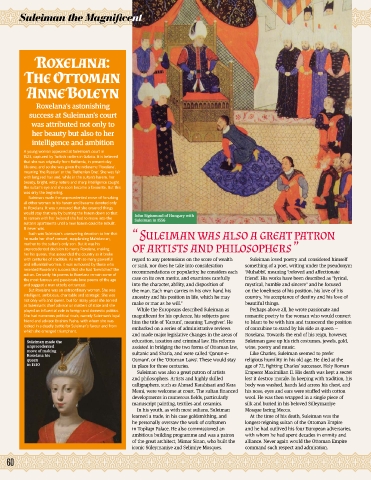
         to remain with her beloved she had to move into the   John Sigismund of Hungary with
                                                Suleiman in 1556
         sultan’s apartments until a new harem could be rebuilt.
         It never was.
           Such was Suleiman’s unwavering devotion to her that   “ Suleiman was also a great patron
         he made her chief consort, supplanting Mahidevran,
         mother to the sultan’s only son. But it was his
         unprecedented decision to marry Roxelana, making   of artists and philosophers ”
         her his queen, that astounded the country as it broke
         with centuries of tradition. As with so many powerful   regard to any pretensions on the score of wealth   Suleiman loved poetry and considered himself
         and influential women, it was rumoured by those who   or rank, nor does he take into consideration   something of a poet, writing under the pseudonym
         resented Roxelana’s success that she had ‘bewitched’ the
         sultan. Certainly his poems to Roxelana remain some of   recommendations or popularity; he considers each   ‘Muhabbi’, meaning ‘beloved and affectionate
         the most famous and passionate love poems of the age   case on its own merits, and examines carefully   friend’. His works have been described as “lyrical,
         and suggest a man utterly entranced.  into the character, ability, and disposition of   mystical, humble and sincere” and he focused
           But Roxelana was an extraordinary woman. She was   the man. Each man carries in his own hand his   on the loneliness of his position, his love of his
         intelligent, ambitious, charitable and strategic. She was   ancestry and his position in life, which he may   country, his acceptance of destiny and his love of
         not only wife and queen, but for many years she served
         as Suleiman’s chief advisor on matters of state and she   make or mar as he will.”  beautiful things.
         played an influential role in foreign and domestic politics.   While the Europeans described Suleiman as   Perhaps above all, he wrote passionate and
         She had numerous political rivals, namely Suleiman’s loyal   magnificent for his opulence, his subjects gave   romantic poetry to the woman who would convert
         friend and advisor Ibrahim Pasha, with whom she was   him the title of ‘Kanuni’, meaning ‘Lawgiver’. He   to Islam to be with him and transcend the position
         locked in a deadly battle for Suleiman’s favour and from
         which she emerged triumphant.         embarked on a series of administrative reviews   of concubine to stand by his side as queen —
                                               and made major legislative changes in the areas of   Roxelana. Towards the end of his reign, however,
           Suleiman made the                   education, taxation and criminal law. His reforms   Suleiman gave up his rich costumes, jewels, gold,
           unprecedented                       assisted in bridging the two forms of Ottoman law,   wine, poetry and music.
           move of making
           Roxelana his                        sultanic and Sharia, and were called ‘Qanun-e-  Like Charles, Suleiman seemed to prefer
           queen                               Osmani’, or the ‘Ottoman Laws’. These would stay   religious humility in his old age. He died at the
           in 1530                             in place for three centuries.           age of 72, fighting Charles’ successor, Holy Roman
                                                 Suleiman was also a great patron of artists   Emperor Maximilian II. His death was kept a secret
                                               and philosophers. Artists and highly skilled   lest it destroy morale. In keeping with tradition, his
                                               calligraphers, such as Ahmad Karahisari and Kara   body was washed, hands laid across his chest, and
                                               Memi, were welcome at court. The sultan financed   his nose, eyes and ears were stuffed with cotton
                                               developments in numerous fields, particularly   wool. He was then wrapped in a single piece of
                                               manuscript painting, textiles and ceramics.  silk and buried in his beloved Süleymaniye
                                                 In his youth, as with most sultans, Suleiman   Mosque facing Mecca.
                                               learned a trade, in his case goldsmithing, and   At the time of his death, Suleiman was the
                                               he personally oversaw the work of craftsmen   longest-reigning sultan of the Ottoman Empire
                                               in Topkapı Palace. He also commissioned an   and he had outlived his four European adversaries,
                                               ambitious building programme and was a patron   with whom he had spent decades in enmity and
                                               of the great architect, Mimar Sinan, who built the   alliance. Never again would the Ottoman Empire
                                               iconic Süleymaniye and Selimiye Mosques.  command such respect and admiration.
   60

