


Page 271 - Inventions - A Visual Encyclopedia (DK - Smithsonian)
P. 271
Apollo 11                 SATURN V
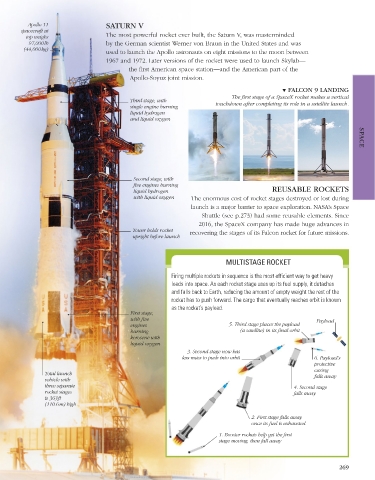
        spacecraft at               The most powerful rocket ever built, the Saturn V, was masterminded
          top weighs
          97,000 lb                 by the German scientist Werner von Braun in the United States and was
         (44,000 kg)
                                    used to launch the Apollo astronauts on eight missions to the moon between
                                    1967 and 1972. Later versions of the rocket were used to launch Skylab—
                                           the first American space station—and the American part of the
                                           Apollo-Soyuz joint mission.

                                                                                             ▼ FALCON 9 LANDING
                                                                             The first stage of a SpaceX rocket makes a vertical
                                           Third stage, with           touchdown after completing its role in a satellite launch.
                                           single engine burning
                                           liquid hydrogen
                                           and liquid oxygen                                                           SPACE


                                             Second stage, with
                                             five engines burning
                                             liquid hydrogen                              REUSABLE ROCKETS
                                             with liquid oxygen  The enormous cost of rocket stages destroyed or lost during
                                                               launch is a major barrier to space exploration. NASA’s Space
                                                                   Shuttle (see p.273) had some reusable elements. Since
                                                                  2016, the SpaceX company has made huge advances in
                                            Tower holds rocket   recovering the stages of its Falcon rocket for future missions.
                                            upright before launch


                                                                           MULTISTAGE ROCKET

                                                         Firing multiple rockets in sequence is the most efficient way to get heavy
                                                         loads into space. As each rocket stage uses up its fuel supply, it detaches
                                                         and falls back to Earth, reducing the amount of empty weight the rest of the
                                                         rocket has to push forward. The cargo that eventually reaches orbit is known
                                                         as the rocket’s payload.
                                            First stage,
                                            with five                                                   Payload
                                            engines                         5. Third stage places the payload
                                            burning                            (a satellite) in its final orbit
                                            kerosene with
                                            liquid oxygen
                                                              3. Second stage now has
                                                            less mass to push into orbit                6. Payload’s
                                                                                                        protective
                                                                                                        casing
                Total launch                                                                            falls away
                vehicle with
                three separate                                                                   4. Second stage
                rocket stages                                                                    falls away
                is 363 ft
                (110.6 m) high
                                                                                   2. First stage falls away
                                                                                   once its fuel is exhausted
                                                                        1. Booster rockets help get the first
                                                                        stage moving, then fall away


                                                                                                                269


   US_268-269_Rockets_Main.indd   269                                                                            02/04/18   3:38 PM

