


Page 272 - Inventions - A Visual Encyclopedia (DK - Smithsonian)
P. 272
Rocket race


                                              Rockets come in a wide variety of shapes and sizes,
                                              from fireworks to battlefield weapons and long-range

                                              missiles. However, the largest and most powerful
                                              rockets are those used to launch satellites and

                                              manned spacecraft into orbit and beyond. Although
                                              the first experiments with liquid-fuel rockets took
      SPACE                                   place in the 1920s, it took military interest in rockets

                                              to make spaceflight a reality.


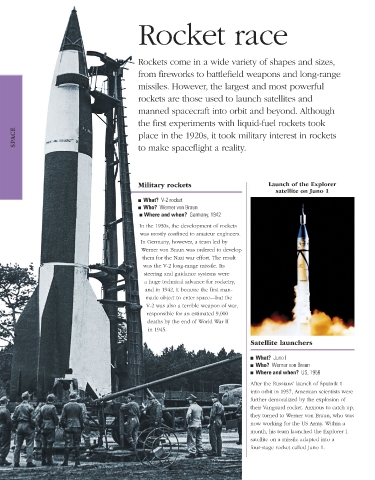
                                              Military rockets                           Launch of the Explorer
                                                                                           satellite on Juno 1
                                              ■ ■ What?  V-2 rocket
                                              ■ ■ Who?  Werner von Braun
                                               ■ ■Where and when?  Germany, 1942
                                               In the 1930s, the development of rockets
                                               was mostly confined to amateur engineers.
                                               In Germany, however, a team led by
                                               Werner von Braun was ordered to develop
                                                them for the Nazi war effort. The result
                                                was the V-2 long-range missile. Its
                                                steering and guidance systems were
                                                a huge technical advance for rocketry,
                                                and in 1942, it became the first man-
                                                 made object to enter space—but the
                                                 V-2 was also a terrible weapon of war,
                                                 responsible for an estimated 9,000
                                                 deaths by the end of World War II
                                                 in 1945.

                                                                                   Satellite launchers


                                                                                   ■ ■ What?  Juno I
                                                                                   ■ ■ Who?  Werner von Braun
                                                                                   ■ ■ Where and when?  US, 1958
                                                                                   After the Russians’ launch of Sputnik 1
                                                                                   into orbit in 1957, American scientists were
                                                                                   further demoralized by the explosion of
                                                                                   their Vanguard rocket. Anxious to catch up,
                                                                                   they turned to Werner von Braun, who was
                                                                                   now working for the US Army. Within a
                                                                                   month, his team launched the Explorer 1
                                                                                   satellite on a missile adapted into a
                                                                                   four-stage rocket called Juno 1.


   US_270-271_Rockets_Gallery.indd   270                                                                         08/03/18   3:10 PM

