


Page 273 - Inventions - A Visual Encyclopedia (DK - Smithsonian)
P. 273
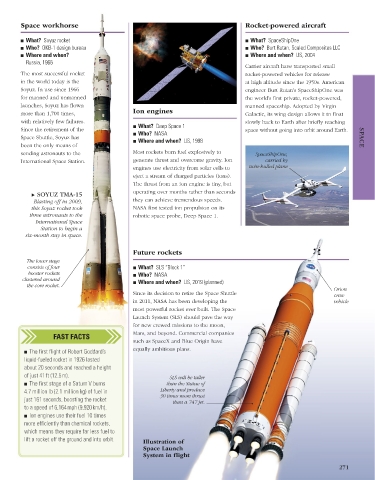
Space workhorse                                                          Rocket-powered aircraft


        ■ ■ What?  Soyuz rocket                                                  ■ ■ What?  SpaceShipOne
        ■ ■ Who?  OKB-1 design bureau                                            ■ ■ Who?  Burt Rutan, Scaled Composites LLC
        ■ ■ Where and when?                                                      ■ ■ Where and when?  US, 2004
          Russia, 1966
                                                                                 Carrier aircraft have transported small
        The most successful rocket                                               rocket-powered vehicles for release
        in the world today is the                                                at high altitude since the 1950s. American
        Soyuz. In use since 1966                                                 engineer Burt Rutan’s SpaceShipOne was
        for manned and unmanned                                                  the world’s first private, rocket-powered,
        launches, Soyuz has flown                                                manned spaceship. Adopted by Virgin
        more than 1,700 times,              Ion engines                          Galactic, its wing design allows it to float
        with relatively few failures.                                            slowly back to Earth after briefly reaching
        Since the retirement of the         ■ ■ What?  Deep Space 1              space without going into orbit around Earth.
                                            ■ ■ Who?  NASA
        Space Shuttle, Soyuz has                                                                                       SPACE
                                            ■ ■ Where and when?  US, 1998
        been the only means of
        sending astronauts to the           Most rockets burn fuel explosively to   SpaceShipOne,
        International Space Station.        generate thrust and overcome gravity. Ion   carried by
                                            engines use electricity from solar cells to   twin-hulled plane
                                            eject a stream of charged particles (ions).
                                            The thrust from an ion engine is tiny, but
           ▶ SOYUZ TMA-15                   operating over months rather than seconds
            Blasting off in 2009,           they can achieve tremendous speeds.
           this Soyuz rocket took           NASA first tested ion propulsion on its
           three astronauts to the          robotic space probe, Deep Space 1.
             International Space
              Station to begin a
         six-month stay in space.


                                            Future rockets
          The lower stage
          consists of four                  ■ ■ What?  SLS “Block 1”
          booster rockets                   ■ ■ Who?  NASA
        clustered around                    ■ ■ Where and when?  US, 2019 (planned)
          the core rocket.
                                                                                                              Orion
                                            Since its decision to retire the Space Shuttle                    crew
                                            in 2011, NASA has been developing the                             vehicle
                                            most powerful rocket ever built. The Space
                                            Launch System (SLS) should pave the way
                                            for new crewed missions to the moon,
                  FAST FACTS                Mars, and beyond. Commercial companies
                                            such as SpaceX and Blue Origin have
         ■ ■ The first flight of Robert Goddard’s   equally ambitious plans.
         liquid-fueled rocket in 1926 lasted
         about 20 seconds and reached a height
         of just 41 ft (12.5 m).                        SLS will be taller
         ■ ■ The first stage of a Saturn V burns       than the Statue of
         4.7 million lb (2.1 million kg) of fuel in    Liberty and produce
         just 161 seconds, boosting the rocket       30 times more thrust
                                                         than a 747 jet.
         to a speed of 6,164 mph (9,920 km/h).
         ■ ■ Ion engines use their fuel 10 times
         more efficiently than chemical rockets,
         which means they require far less fuel to
         lift a rocket off the ground and into orbit.  Illustration of
                                                Space Launch
                                                System in flight
                                                                                                                271


   US_270-271_Rockets_Gallery.indd   271                                                                         08/03/18   3:10 PM

