


Page 16 - (DK) The Dog Encyclopedia
P. 16
INTRODUCTION TO DOGS  |  CARDIOVASCULAR AND DIGESTIVE SYSTEMS


          Cardiovascular and


          digestive systems


          The major body systems that keep a dog, and all other mammals, up and running can
          function only by working together. Oxygen drawn in by the lungs and nutrients
          contributed by the digestive system are the essential fuels of life and must be
          transported to every part of the body. Circulating blood, driven through a network of
          arteries and veins by the steady beating of the heart, provides the vital supply line.


          CIRCULATION AND RESPIRATION               dioxide, produced by cell activity. Blood   warm air that causes saliva in its mouth to
          A dog’s heart functions in the same way as   flows in a continuous circuit, picking up   evaporate—latent heat is lost, and the dog’s
          our own, pumping with a regular rhythm to   oxygen from inhaled air in the lungs, and   body temperature decreases as a result.
          keep blood moving around the body. Inside   then carrying it, together with nutrients   Also invaluable for dogs, especially
          the muscular walls of the heart there are   absorbed through the intestinal walls,   cold-climate spitz breeds, is an adaptation
          four chambers that contract and relax in a   around the entire body. At the same time   to the cardiovascular system that prevents
          sequence with each heartbeat. This forces   that oxygen is collected in the lungs, carbon   excessive loss of body heat through the
          blood out of the heart through the arteries   dioxide diffuses out of the bloodstream and   paws when in contact with cold ground.
          and into circulation and allows the heart to   is expelled from the body in exhaled breath.
          refill with blood returning via the veins.   The respiratory system also has a vital role
           This circulatory, or cardiovascular, system  in preventing a dog’s body from overheating.
          operates in conjunction with the respiratory   Because a dog has only a few sweat glands,
          system to bring oxygen to every cell in the   mostly in its paws, it cannot keep cool by
          body and to remove waste, such as carbon   perspiring. Instead, a dog pants, exhaling


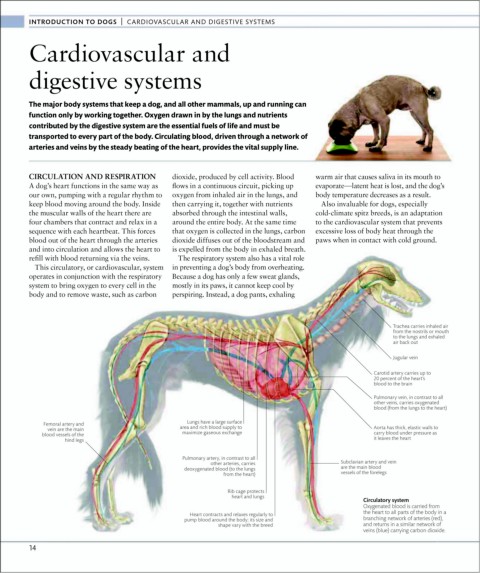
                                                                                                                      Trachea carries inhaled air
                                                                                                                      from the nostrils or mouth
                                                                                                                      to the lungs and exhaled
                                                                                                                      air back out

                                                                                                                      Jugular vein

                                                                                                                Carotid artery carries up to
                                                                                                                20 percent of the heart’s
                                                                                                                blood to the brain

                                                                                                                Pulmonary vein, in contrast to all
                                                                                                                other veins, carries oxygenated
                                                                                                                blood (from the lungs to the heart)
                                                         Lungs have a large surface
              Femoral artery and
               vein are the main                       area and rich blood supply to                            Aorta has thick, elastic walls to
             blood vessels of the                      maximize gaseous exchange                                carry blood under pressure as
                    hind legs                                                                                   it leaves the heart

                                                       Pulmonary artery, in contrast to all
                                                                other arteries, carries               Subclavian artery and vein
                                                        deoxygenated blood (to the lungs              are the main blood
                                                                   from the heart)                    vessels of the forelegs

                                                                     Rib cage protects
                                                                      heart and lungs
                                                                                                             Circulatory system
                                                                                                             Oxygenated blood is carried from
                                                                                                             the heart to all parts of the body in a
                                                         Heart contracts and relaxes regularly to
                                                        pump blood around the body; its size and             branching network of arteries (red),
                                                                  shape vary with the breed                  and returns in a similar network of
                                                                                                             veins (blue) carrying carbon dioxide.

          14

