


Page 18 - Shark
P. 18
Continued from previous page

        Tails and more tails

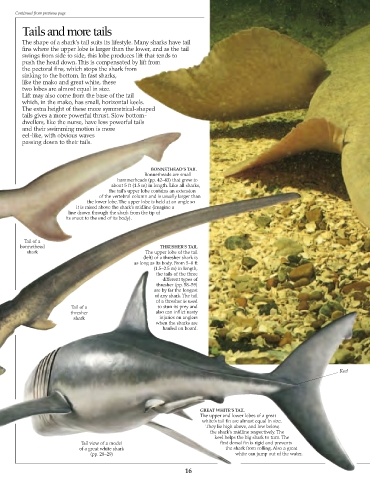
        The shape of a shark’s tail suits its lifestyle. Many sharks have tail
        fins where the upper lobe is larger than the lower, and as the tail
        swings from side to side, this lobe produces lift that tends to
        push the head down. This is compensated by lift from
        the pectoral fins, which stops the shark from
        sinking to the bottom. In fast sharks,
        like the mako and great white, these
        two lobes are almost equal in size.
        Lift may also come from the base of the tail
        which, in the mako, has small, horizontal keels.
        The extra height of these more symmetrical-shaped
        tails gives a more powerful thrust. Slow bottom-
        dwellers, like the nurse, have less powerful tails
        and their swimming motion is more
        eel-like, with obvious waves
        passing down to their tails.


                                                   Bonnethead’s tail
                                                 Bonnetheads are small
                                        hammerheads (pp. 42–43) that grow to
                                      about 5 ft (1.5 m) in length. Like all sharks,
                                     the tail’s upper lobe contains an extension
                                  of the vertebral column and is usually larger than
                              the lower lobe. The upper lobe is held at an angle so
                          it is raised above the shark’s midline (imagine a
                        line drawn through the shark from the tip of
                       its snout to the end of its body).


         Tail of a
        bonnethead                                    thresher’s tail
          shark                                  The upper lobe of the tail
                                                (left) of a thresher shark is
                                             as long as its body. From 5–8 ft
                                                    (1.5–2.5 m) in length,
                                                     the tails of the three
                                                       different types of
                                                     thresher (pp. 58–59)
                                                    are by far the longest
                                                    of any shark. The tail
                                                     of a thresher is used
                         Tail of a                   to stun its prey and
                        thresher                     also can inflict nasty
                         shark                        injuries on anglers
                                                     when the sharks are
                                                       hauled on board.


                                                                                                                 Keel


                                                                   Great white’s tail
                                                                   The upper and lower lobes of a great
                                                                    white’s tail fin are almost equal in size.
                                                                     They lie high above, and low below,
                                                                       the shark’s midline respectively. The
                                                                        keel helps the big shark to turn. The
                            Tail view of a model                          first dorsal fin is rigid and prevents
                           of a great white shark                           the shark from rolling. Also a great
                               (pp. 28–29)                                     white can jump out of the water.

                                                              16

