


Page 254 - Portuguese Dictionary Phrasebook (The Rough Guide)
P. 254
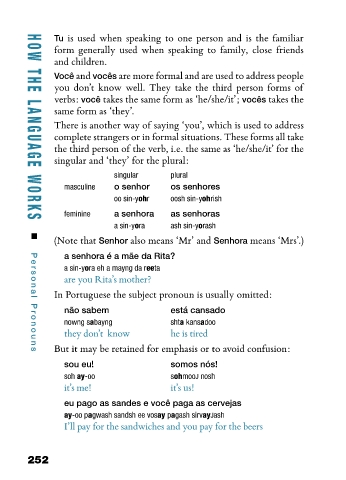
Tu is used when speaking to one  person and is the familiar
                 form generally used when speaking to family, close friends
                 and children.
                 V Você and vocês are more formal and are used to address people
                 you don’t know well. They take the third  person forms of f
                 verbs: você takes the same form as ‘he/she/it’; vocês takes the
                 same form as ‘they’.
                 There is another way of saying ‘you’, which is used to address
                 complete strangers or in formal situations. These forms all take
                 the third person of the verb, i.e. the same as ‘he/she/it’ for the
                 singular and ‘they’ for the plural:
                           singular  plural
                   masculine  o senhor  os senhores
                           oo sin-yohr  oosh sin-yohrish
                   feminine  a senhora  as senhoras
                           a sin-yora  ash sin-yorash
             HOW THE LANGUAGE WORKS
                 (Note that Senhor also means ‘Mr’ and r  Senhora means ‘Mrs’.)
             N
                   a senhora é a mãe da Rita?
                   a sin-yora eh a mayng da reeta
                   are you Rita’s mother?
                 In Portuguese the subject pronoun is usually omitted:
             Personal
                   não sabem         está cansado
                   nowng sabayng     shta kansadoo
                   they don’t  know  he is tired
                 But it may be retained for emphasis or to avoid confusion:
             Pr onouns
                   sou eu!           somos nós!
                   soh ay-oo         sohmooJ nosh
                   it’s me!          it’s us!
                   eu pago as sandes e você paga as cervejas
                   ay-oo pagwash sandsh ee vosay pagash sirvayJash
                   I’ll pay for the sandwiches and you pay for the beers


             252


 RG New PORTUGUESE How the Langua252   25252  25252

