


Page 258 - Portuguese Dictionary Phrasebook (The Rough Guide)
P. 258
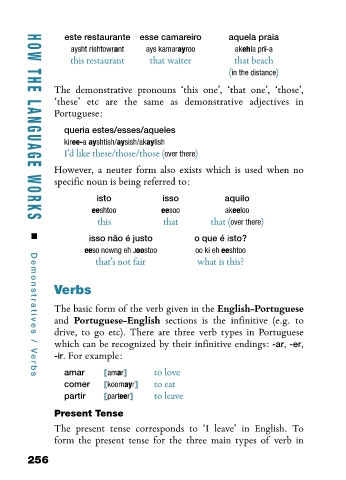
este restaurante  esse camareiro
                                                akehla prīr -a
                    aysht rishtowrant
                                 that waiter
                                                that beach
                    this restaurant  ays kamarayroo  aquela praia
                                               (in the distance)
                 The  demonstrative pronouns ‘this one’, ‘that one’, ‘those’,
                 ‘these’ etc are the same as  demonstrative adjectives in
                 Portuguese:
                   queria estes/esses/aqueles
                   kiree-a ayshtish/aysish/akaylish
                   I’d like these/those/those (over there)
                 However, a neuter form also exists which is used when no
                 specific noun is being referred to:
                        isto        isso      aquilo
                        eeshtoo    eesoo      akeeloo
                        this        that    that (over there)
             HOW THE LANGUAGE WORKS
                       isso não é justo  o que é isto?
             N
                      eeso nowng eh Joostoo  oo ki eh eeshtoo
                        that’s not fair  what is this?
                 Verbs
                 The basic form of the verb given in the English-Portuguese
                 and Portuguese-English sections is the infinitive  (e.g. to
                 drive, to  go etc). There are three verb types in Portuguese
             Demonstratives
                 which can be recognized by their infinitive endings: -ar, -er,
             /
                 -ir. For example:
                   amar   [amar]  to love
             Verbs
                   comer  [koomayr]  to eat
                   partir  [parteer]  to leave
                 Present Tense
                 The  present tense corresponds to ‘I leave’ in English. To
                 form the  present tense for the three main types of verb in
             256


 RG New PORTUGUESE How the Langua256   25656 2566

