


Page 256 - Portuguese Dictionary Phrasebook (The Rough Guide)
P. 256
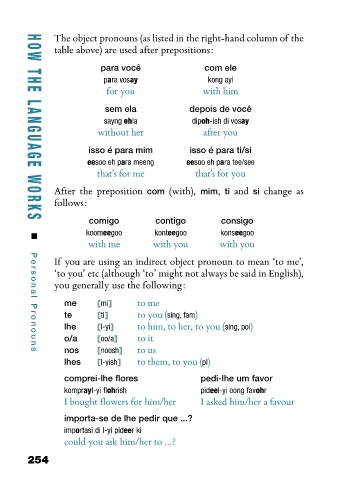
table above) are used after prepositions:
                         para você
                                           com ele
                   The object pronouns (as listed in the right-hand column of the
                          para vosay       kong ayl
                          for you         with him
                          sem ela       depois de você
                          sayng ehla     dipoh-ish di vosay
                         without her      after you
                       isso é para mim   isso é para ti/si
                       eesoo eh para meeng  eesoo eh para tee/see
                        that’s for me    that’s for you
                 After the preposition com (with),  mim, ti and  si change as
                 follows:
                       comigo     contigo     consigo
             HOW THE LANGUAGE WORKS
                       koomeegoo  konteegoo  konseegoo
                       with me    with you   with you
             N
                 If you are using an indirect object pronoun to mean ‘to me’,
                 ‘to you’ etc (although ‘to’ might not always be said in English),
                 you generally use the following:
             Personal
                   me   [mi]   to me
                   te   [ti]   to you (sing, fam)
                   lhe  [l-yi]  to him, to her, to you (sing, pol)
                   o/a  [oo/a]  to it
                   nos  [noosh]  to us
             Pr onouns
                   lhes  [l-yish]  to them, to you (pl)
                   comprei-lhe flores     pedi-lhe um favor
                   komprayl-yi flohrish   pideel-yi oong favohr
                   I bought flowers for him/her  I asked him/her a favour
                   importa-se de lhe pedir que ...?
                   importasi di l-yi pideerki
                   could you ask him/her to ...?
             254


 RG New PORTUGUESE How the Langua254   25454 25544

