


Page 260 - Portuguese Dictionary Phrasebook (The Rough Guide)
P. 260
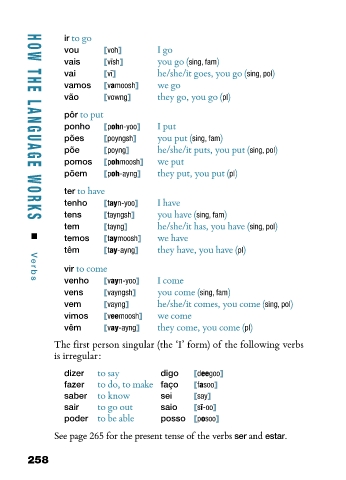
ir to go
                   vou
                                   you go (sing, fam)
                   vais   [voh]    I go
                          [vīsh]
                   vai    [vī]     he/she/it goes, you go (sing, pol)
                   vamos  [vamoosh]  we go
                   vão    [vowng]  they go, you go (pl)
                   pôr to put
                   ponho  [pohn-yoo]  I put
                   pões   [poyngsh]  you put (sing, fam)
                   põe    [poyng]  he/she/it puts, you put (sing, pol)
                   pomos  [pohmoosh]  we put
                   põem   [poh-ayng]  they put, you put (pl)
                   ter to have
                   tenho  [tayn-yoo]  I have
                   tens   [tayngsh]  you have (sing, fam)
                   tem    [tayng]  he/she/it has, you have (sing, pol)
             HOW THE LANGUAGE WORKS
                   temos  [taymoosh]  we have
                   têm    [tay-ayng]  they have, you have (pl)
             N
                   vir to come
                   venho  [vayn-yoo]  I come
             Verbs
                   vens   [vayngsh]  you come (sing, fam)
                   vem    [vayng]  he/she/it comes, you come (sing, pol)
                   vimos  [veemoosh]  we come
                   vêm    [vay-ayng]  they come, you come (pl)
                 The first person singular (the ‘I’ form) of the following verbs
                 is irregular:
                   dizer  to say   digo  [deegoo]
                   fazer  to do, to make  faço  [fasoo]
                   saber  to know  sei   [say]
                   sair  to go out  saio  [sī-oo]
                   poder to be able  posso  [posoo]
                 See page 265 for the present tense of the verbs ser andr  estar.

             258


 RG New PORTUGUESE How the Langua258   25858 2588

