


Page 261 - Portuguese Dictionary Phrasebook (The Rough Guide)
P. 261
Past Tense:
               Preterite Tense
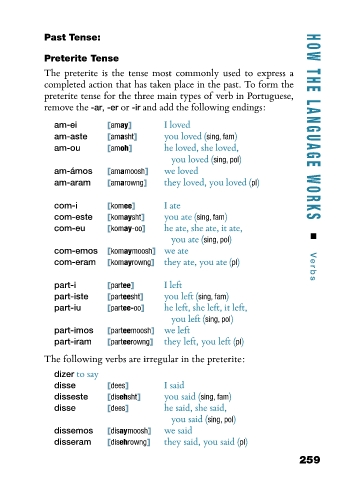
               The preterite is the tense most commonly used to express a
               completed action that has taken place in the past. To form the
               preterite tense for the three main types of verb in Portuguese,
               remove the -ar, -er or r  -ir and add the following endings:r
                 am-ei    [amay]    I loved
                 am-aste  [amasht]  you loved (sing, fam)   HOW THE LANGUAGE WORKS
                 am-ou    [amoh]    he loved, she loved,
                                     you loved (sing, pol)
                 am-ámos  [amamoosh]  we loved
                 am-aram  [amarowng]  they loved, you loved (pl)
                 com-i    [komee]   I ate
                 com-este  [komaysht]  you ate (sing, fam)
                 com-eu   [komay-oo]  he ate, she ate, it ate,
                                     you ate (sing, pol)     N
                 com-emos  [komaymoosh] we ate
                 com-eram  [komayrowng] they ate, you ate (pl)  Verbs
                 part-i   [partee]  I left
                 part-iste  [parteesht]  you left (sing, fam)
                 part-iu  [partee-oo]  he left, she left, it left,
                                     you left (sing, pol)
                 part-imos  [parteemoosh] we left
                 part-iram  [parteerowng]  they left, you left (pl)
               The following verbs are irregular in the preterite:
                 dizer to say
                 disse    [dees]    I said
                 disseste  [disehsht]  you said (sing, fam)
                 disse    [dees]    he said, she said,
                                     you said (sing, pol)
                 dissemos  [disaymoosh]  we said
                 disseram  [disehrowng]  they said, you said (pl)
                                                           259

