


Page 22 - Dinosaur (DK Eyewitness Books)
P. 22
The first fossil finds


                                    PȦȰȱȭȦ ȩȢȥ ȣȦȦȯ ȶȯȦȢȳȵȩȪȯȨ the fossil bones of giant creatures long
                                    before they knew they were discovering what we call dinosaurs. Scientific
                                    dinosaur discovery began in England in the early 1820s. A doctor named
                                    Gideon Mantell began collecting large fossilized bones and teeth dug up in
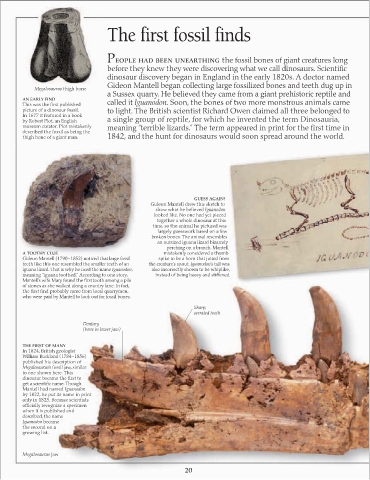
            Megalosaurus thigh bone
                                    a Sussex quarry. He believed they came from a giant prehistoric reptile and
        AN EARLY FIND
        This was the first published   called it Iguanodon. Soon, the bones of two more monstrous animals came
        picture of a dinosaur fossil.    to light. The British scientist Richard Owen claimed all three belonged to
        In 1677 it featured in a book
        by Robert Plot, an English   a single group of reptile, for which he invented the term Dinosauria,
        museum curator. Plot mistakenly   meaning “terrible lizards.” The term appeared in print for the first time in
        described the fossil as being the
        thigh bone of a giant man.  1842, and the hunt for dinosaurs would soon spread around the world.


                                                                 GUESS AGAIN!
                                                   Gideon Mantell drew this sketch to
                                                     show what he believed Iguanodon
                                                    looked like. No one had yet pieced
                                                     together a whole dinosaur at this
                                                    time, so the animal he pictured was
                                                     largely guesswork based on a few
                                                   broken bones. The animal resembles
                                                     an outsized iguana lizard bizarrely
                                                        perching on a branch. Mantell
        A TOOTHY CLUE                                  mistakenly considered a thumb
        Gideon Mantell (1790–1852) noticed that large fossil   spike to be a horn that jutted from
        teeth like this one resembled the smaller teeth of an   the creature’s snout. Iguanodon’s tail was
        iguana lizard. That is why he used the name Iguanodon,  also incorrectly shown to be whiplike,
        meaning “iguana toothed.” According to one story,   instead of being heavy and stiffened.
        Mantell’s wife Mary found the first tooth among a pile
        of stones as she walked along a country lane. In fact,
        the first find probably came from local quarrymen,
        who were paid by Mantell to look out for fossil bones.
                                                                 Sharp,
                                                                 serrated tooth
                             Dentary
                             (bone in lower jaw)

        THE FIRST OF MANY
        In 1824, British geologist
        William Buckland (1784–1856)
        published his description of
        Megalosaurus’s fossil jaw, similar
        to one shown here. This
        dinosaur became the first to
        get a scientific name. Though
        Mantell had named Iguanodon
        by 1822, he put its name in print
        only in 1825. Because scientists
        officially recognize a specimen
        when it is published and
        described, the name
        Iguanodon became
        the second on a
        growing list.


        Megalosaurus jaw

                                                              20

