


Page 48 - Dinosaur (DK Eyewitness Books)
P. 48
Arms and hands
                           Humerus
                           (upper arm bone)

                                                       DȪȯȰȴȢȶȳȴp ȢȳȮȴ Ȣȯȥ ȩȢȯȥȴ evolved in amazingly
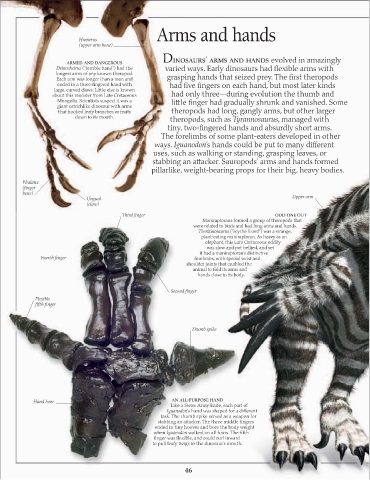
                       ARMED AND DANGEROUS
                    Deinocheirus (“terrible hand”) had the   varied ways. Early dinosaurs had flexible arms with
                    longest arms of any known theropod.
                    Each arm was longer than a man and   grasping hands that seized prey. The first theropods
                    ended in a three-fingered hand with   had five fingers on each hand, but most later kinds
                   large, curved claws. Little else is known
                  about this monster from Late Cretaceous   had only three—during evolution the thumb and
                    Mongolia. Scientists suspect it was a   little finger had gradually shrunk and vanished. Some
                    giant ostrichlike dinosaur with arms
                    that hooked leafy branches or fruits    theropods had long, gangly arms, but other larger
                          down to its mouth.
                                                         theropods, such as Tyrannosaurus, managed with
                                                        tiny, two-fingered hands and absurdly short arms.
                                                      The forelimbs of some plant-eaters developed in other
                                                    ways. Iguanodon’s hands could be put to many different
                                                    uses, such as walking or standing, grasping leaves, or
                                                   stabbing an attacker. Sauropods’ arms and hands formed
                                                   pillarlike, weight-bearing props for their big, heavy bodies.

        Phalanx
        (finger
        bone)
                              Ungual                                                              Upper arm
                              (claw)
                                         Third finger                                       ODD ONE OUT
                                                                    Maniraptorans formed a group of theropods that
                                                                 were related to birds and had long arms and hands.
                                                                   Therizinosaurus (“scythe lizard”) was a strange,
                                                                    plant-eating maniraptoran. As heavy as an
                                                                     elephant, this Late Cretaceous oddity
                                                                     was slow and pot-bellied, and yet
                                                                   it had a maniraptoran’s distinctive
               Fourth finger                                     forelimbs, with special wrist and
                                                               shoulder joints that enabled the
                                                                 animal to fold its arms and
                                                                  hands close to its body.


                                                          Second finger
             Flexible
             fifth finger


                                                                Thumb spike


            Hand bone                                     $1 $//ʜ385326( +$1'
                                                         Like a Swiss Army knife, each part of
                                                        Iguanodon’s hand was shaped for a different
                                                      task. The thumb spike served as a weapon for
                                                     stabbing an attacker. The three middle fingers
                                                    ended in tiny hooves and bore the body weight
                                                    when Iguanodon walked on all fours. The fifth
                                                    finger was flexible, and could curl inward
                                                   to pull leafy twigs to the dinosaur’s mouth.


                                                              46

