


Page 47 - Dinosaur (DK Eyewitness Books)
P. 47
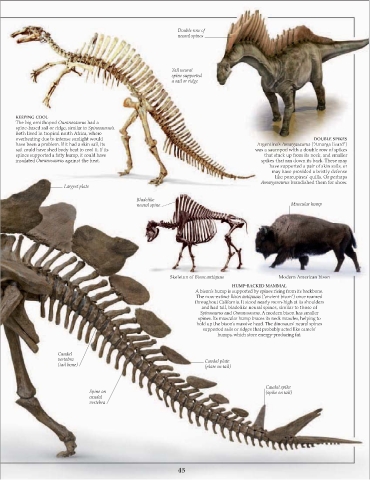
Double row of
                                                            neural spines


                                                          Tall neural
                                                          spine supported
                                                          a sail or ridge


      KEEPING COOL
      The big ornithopod Ouranosaurus had a
      spine-based sail or ridge, similar to Spinosaurus’s.
      Both lived in tropical north Africa, where
      overheating due to intense sunlight would                                                          DOUBLE SPIKES
      have been a problem. If it had a skin sail, its                                 Argentina’s Amargasaurus (“Amarga lizard”)
      sail could have shed body heat to cool it. If its                              was a sauropod with a double row of spikes
      spines supported a fatty hump, it could have                                      that stuck up from its neck, and smaller
      insulated Ouranosaurus against the heat.                                         spikes that ran down its back. These may
                                                                                          have supported a pair of skin sails, or
                                                                                           may have provided a bristly defense
                                                                                            like porcupines’ quills. Or perhaps
                                                                                       Amargasaurus brandished them for show.
                      Largest plate

                                              Bladelike
                                              neural spine                                       Muscular hump


                                                         Skeleton of Bison antiquus          Modern American bison
                                                                              +U0PʜB$CKED 0$00$L
                                                                  A bison’s hump is supported by spines rising from its backbone.
                                                                  The now-extinct Bison antiquuus (“ancient bison”) once roamed
                                                                 throughout California. It stood nearly room-high at its shoulders
                                                                    and had tall, bladelike neural spines, similar to those of
                                                                   Spinosaurus and Ouranosaurus. A modern bison has smaller
                                                                   spines. Its muscular hump braces its neck muscles, helping to
                                                                  hold up the bison’s massive head. The dinosaurs’ neural spines
                                                                    supported sails or ridges that probably acted like camels’
                                                                         humps, which store energy-producing fat.


                    Caudal
                    vertebra
                                                                     Caudal plate
                    (tail bone)
                                                                     (plate on tail)

                                                                                         Caudal spike
                               Spine on                                                  (spike on tail)
                               caudal
                               vertebra


                                                            45

