


Page 102 - How It Works - Book Of Amazing Answers To Curious Questions, Volume 05-15
P. 102
How will NASA blow up asteroids?


            How NASA plans to save us from killer space rocks

                t was 66 million years ago that the
                dinosaurs’ reign on Earth came to an
            Iend. The instigator was an asteroid, a
            large lump of space rock of around ten
            kilometres (six miles) in diameter, which
            struck the Earth with a force that was one
            billion times greater than that of the
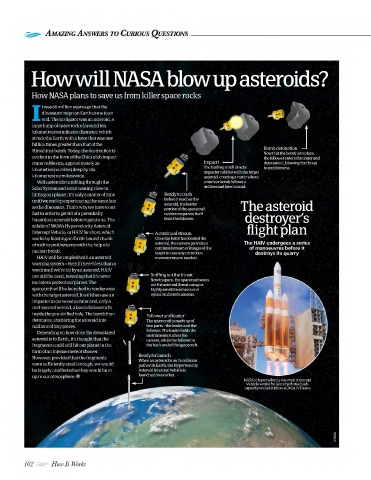
                                                                                              Bomb detonation
            Hiroshima bomb. Today, the destruction is
                                                                                              Now that the bomb is in place,
            evident in the form of the Chicxulub impact                                       the follower enters the crater and
            crater in Mexico, approximately 20                           Impact!              detonates it, blowing the threat
                                                                         The leading small kinetic   to smithereens.
            kilometres (12 miles) deep by 180
                                                                         impactor collides with the target
            kilometres (112 miles) wide.                                 asteroid, creating a crater where
              With asteroids tumbling through the                        a nuclear bomb follows a
            Solar System and some coming close to                        millisecond later to land.
            hitting our planet, it’s only a matter of time   Ready to crash
            until we end up experiencing the same fate     Before it reaches the
                                                           asteroid, the leader
            as the dinosaurs. That’s why we have to act    portion of the spacecraft   The asteroid
            fast in order to get rid of a potentially      needs to separate itself
            hazardous asteroid before it gets to us. The   from the follower.          destroyer’s
            solution? NASA’s Hypervelocity Asteroid
            Intercept Vehicle, or HAIV for short, which   A continual stream            fl ight     plan
            works by blasting an Earth-bound chunk      Once the HAIV has located the
            of rock to smithereens with the help of a   asteroid, the camera provides a   The HAIV undergoes a series
                                                        continual stream of images of the   of manoeuvres before it
            nuclear bomb.                               target in case any correction      destroys its quarry
              HAIV will be coupled with an asteroid     manoeuvres are needed.
            warning system – even if there’s less than a
            week until we’re hit by an asteroid, HAIV
            can still be used, meaning that it’s never   Sniffing out the threat
                                                      Now in space, the spacecraft seeks
            too late to protect our planet. The
                                                      out the asteroid threat using its
            spacecraft will be launched to rendezvous   highly sensitive sensors and
            with the target asteroid. It will then use an   optical/infrared cameras.
            impactor to carve out a crater and, only a
            millisecond behind, a bomb follows to fit
            inside the pre-drilled hole. The bomb then   Follower and leader
            detonates, shattering the asteroid into   The spacecraft is made up of
            millions of tiny pieces.                two parts – the leader and the
                                                    follower. The leader holds the
              Depending on how close the devastated
                                                    instruments such as the
            asteroid is to Earth, it’s thought that the   camera, while the follower is
            fragments could still hit our planet in the   the back-end of the spacecraft.
            form of an intense meteor shower.
                                                  Ready for launch
            However, provided that the fragments
                                                  When an asteroid is on its collision
            were sufficiently small enough, we would   path with Earth, the Hypervelocity
            be largely unaffected as they would burn   Asteroid Intercept Vehicle is
            up in our atmosphere.                 launched on a rocket.
                                                                                       NASA’s Hypervelocity Asteroid Intercept
                                                                                        Vehicle would be launched on a high-
                                                                                       capacity rocket such as a Delta IV Heavy


                                                                                                                       © NASA


          102       How It Works

