


Page 101 - How It Works - Book Of Amazing Answers To Curious Questions, Volume 05-15
P. 101
Space


                                                                   0.1% Oth
                            <1% Oth                              0.9% Ar

                                                                                                         7% Oth
                         10% Ar
                                                               21% O
                                                                   2
                                                                                                    22% H
                                                                                                        2
                                                                                                                   42% O
                                                                                                                        2

                               90% H                                 78% N
                                   2                                     2
                                                                                                          29% Na
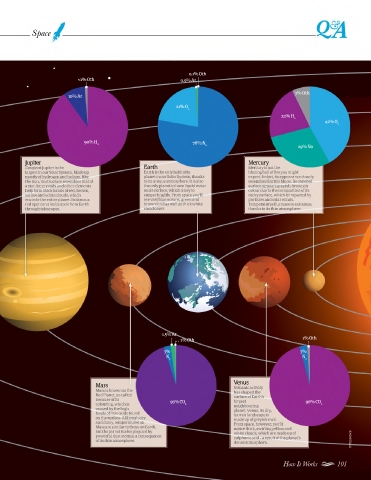
          Jupiter                                                                       Mercury
          Gas giant Jupiter is the                  Earth                               Mercury is not the

          largest in our Solar System. Made up      Earth is the only habitable         blazing ball of fire you might
          mostly of hydrogen and helium, like       planet in our Solar System, thanks   expect. In fact, its appearance closely
          the Sun, its structure resembles that of   to its unique atmosphere. It is also   resembles Earth’s Moon. Its cratered
          a star. Ice crystals and other elements   the only planet to have liquid water   surface appears greyish-brown in
          help form thick bands of red, brown,      on its surface, which is key to     colour due to the composition of its
          yellow and white clouds, which            supporting life. From space you’ll   rocky surface, which is impacted by
          encircle the entire planet. Its famous    see vast blue oceans, green and     particles and solar winds.
          red spot can also be seen from Earth      brown land as well as thick white   Temperatures fluctuate to extremes,

          through telescopes.                       cloud cover.                        thanks to its thin atmosphere.


                                                          1.5% Ar
                                                                1% Oth                                     1% Oth
                                                           3%                                              3%
                                                           N                                               N
                                                            2                                               2


                                                                                   Venus
                                   Mars                                            Volcanic activity
                                   Mars is known as the                            has shaped the
                                   Red Planet, so called                           surface of Earth’s
                                   because of its            95% CO                largest                  96% CO
                                   colouring, which is            2                neighbouring                   2
                                   caused by the high                              planet, Venus. Its dry,
                                   levels of iron oxide found                      barren landscape is
                                   on the surface. Although dry                    made up of greyish rock.
                                   and dusty, temperatures on                      From space, however, you’ll
                                   Mars are similar to those on Earth,             notice thick, swirling yellow and
                                   but the planet is also plagued by               white clouds, which are made up of
                                   powerful dust storms, a consequence             sulphuric acid – a result of the planet’s
                                   of its thin atmosphere.                         dense atmosphere.                        © Thinkstock


                                                                                                     How It Works
                                                                                                                        101
                                                                                                     How It Works        101

