


Page 106 - How It Works - Book Of Amazing Answers To Curious Questions, Volume 05-15
P. 106
What is the                            Solar power                                     Sunny spot

                                                Insight’s solar arrays are
                                                                                                The target can be
                                                vital for keeping its                           anywhere on Mars as long
                                                                                                as it’s along the equator,
         new Mars                               duration of the mission.                        for maximum sunshine.
                                                instruments powered for the
         lander?


          NASA’s next mission

          will offer clues about
          the formation of the
          Solar System

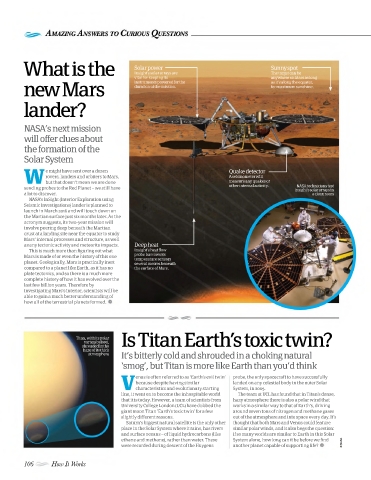
                 e might have sent over a dozen                                   Quake detector
                 rovers, landers and orbiters to Mars,                            A seismometer will
         Wbut that doesn’t mean we are done                                       measure any quakes or
          sending probes to the Red Planet – we still have                        other internal activity.  NASA technicians test
                                                                                                         Insight’s solar arrays in
          a lot to discover.                                                                                   a clean room
           NASA’s InSight (Interior Exploration using
          Seismic Investigations) lander is planned to
          launch in March 2016 and will touch down on
          the Martian surface just six months later. As the
          acronym suggests, its two-year mission will
          involve peering deep beneath the Martian
          crust at a landing site near the equator to study
          Mars’ internal processes and structure, as well
          as any tectonic activity and meteorite impacts.    Deep heat
           This is much more than figuring out what   Insight’s heat fl ow

          Mars is made of or even the history of this one   probe burrows its
                                                temperature sensors
          planet. Geologically, Mars is practically inert   several metres beneath
          compared to a planet like Earth, as it has no   the surface of Mars.
          plate tectonics, and so there is a much more
          complete history of how it has evolved over the
          last few billion years. Therefore by
          investigating Mars’s interior, scientists will be
          able to gain a much better understanding of
          how all of the terrestrial planets formed.


                            Titan, with its polar   Is Titan Earth’s toxic twin?
                               vortex (below),
                              shrouded in the
                              haze of its thick
                                            It’s bitterly cold and shrouded in a choking natural
                                atmosphere
                                            ‘smog’, but Titan is more like Earth than you’d think
                                                 enus is often referred to as ‘Earth’s evil twin’   probe, the only spacecraft to have successfully
                                                 because despite having similar    landed on any celestial body in the outer Solar
                                            Vcharacteristics and evolutionary starting   System, in 2005.
                                            line, it went on to become the inhospitable world   The team at UCL has found that in Titan’s dense,
                                            that it is today. However, a team of scientists from   hazy atmosphere there is also a polar wind that
                                            University College London (UCL) have dubbed the   works in a similar way to that of Earth’s, driving
                                            giant moon Titan ‘Earth’s toxic twin’ for a few   around seven tons of nitrogen and methane gases
                                            slightly different reasons.            out of the atmosphere and into space every day. It’s
                                             Saturn’s biggest natural satellite is the only other   thought that both Mars and Venus could feature
                                            place in the Solar System where it rains, has rivers   similar polar winds, and it also begs the question:
                                            and surface oceans – of liquid hydrocarbons (like   if so many worlds are similar to Earth in this Solar
                                            ethane and methane), rather than water. These   System alone, how long can it be before we fi nd   © NASA
                                            were recorded during descent of the Huygens   another planet capable of supporting life?


          106       How It Works

