


Page 160 - How It Works - Book Of Amazing Answers To Curious Questions, Volume 05-15
P. 160
How did Ancient Greek


          sculptors work?


          Learn the ancient methods of the Greeks who cast legends into stone

               ncient Greece was a civilisation full of   The tools and techniques that the stonemasons   Making of a
               drama, majesty and legend that is   used have changed very little over thousands of
         Aevident in the art they left behind.   years and are similar to the ones worked with   masterpiece
          However, many of the statues that we know are   today. Marble was the most popular to use, but   The steps taken by Ancient Greeks
          actually copies of Roman origin – we owe the   sculptors would pick their blocks for their   to create their iconic sculptures
          Romans a lot for their preservation of art that   workability rather than beauty.
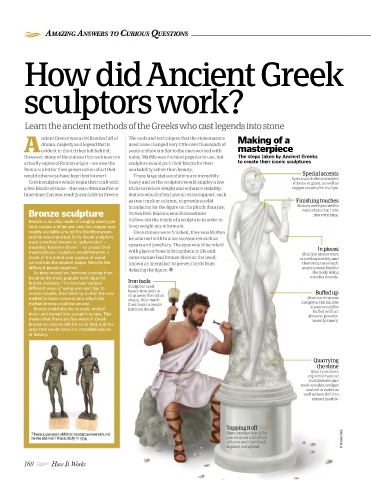
          would otherwise have been lost forever!  These large statues of stone are incredibly             Special accents
                                                                                                       Eyes would often be added
           Greek sculptors would begin their craft with   heavy and so the sculptors would employ a few   in bone or glass, as well as
          a few blocks of stone – this was often marble or   tricks to reduce weight and enhance stability.   copper accents for the lips.
          limestone that was readily available in Greece.   Statues would often have an extra support, such
                                              as tree trunk or column, to provide a solid                Finishing touches
                                              foundation for the figure on the plinth than just           Statues were painted to

           Bronze sculpture                   its two feet. Masons would sometimes                         make them that little
                                                                                                               more striking.
           Bronze is an alloy made of roughly ninety per   hollow-out the inside of a sculpture in order to
           cent copper and ten per cent tin; copper was   keep weight at a minimum.
           readily available around the Mediterranean   Once statues were finished, they would often

           and tin was imported. Early Greek sculptors   be adorned with bronze accessories such as
           used a method known as ‘sphyrelaton’ –
           meaning ‘hammer-driven’ – to create their   spears and jewellery. The eyes would be inlaid            In pieces
           masterpieces. Sculptors would hammer a   with glass or bone to bring them to life and           Multiple pieces were
           sheet of the metal over a piece of wood   some statues had bronze discs on the head,           carved separately and
           carved into the desired shape, then fi x the   known as ‘meniskoi’ to prevent birds from         then structures such
           different pieces together.         defacing the fi gure.                                         as arms were fi xed to
             As time moved on, lost-wax casting then                                                           the body using
           became the most popular technique for                                                              wooden dowels.
           bronze statuary. This involved various   Iron tools
           different ways of using wax and clay to   Sculptors used
                                              heavy iron tools to
           create moulds, then heating so that the wax   chip away the initial                                  Buffed up
           melted to leave a recess into which the   shape, then much                                        Once carving was
           molten bronze could be poured.     finer tools to create                                         complete, the marble

             Bronze could also be re-used, melted   intricate detail.                                         statue would be
                                                                                                               buffed with an
           down and turned into something new. This                                                          abrasive powder,
           means that there are few Ancient Greek                                                              usually emery.
           bronze sculptures left for us to find, and the

           ones that we do have are incredible pieces
           of history.
                                                                                                               Quarrying
                                                                                                                the stone
                                                                                                              Quarry workers
                                                                                                             exploited natural
                                                                                                              rock fi ssures and
                                                                                                           used wooden wedges
                                                                                                             soaked in water as
                                                                                                            well as bow drills to
                                                                                                               extract marble.


                                                                                 Topping it off
            These 2,500 year old bronze statues were found                       Many statues would be
            in the sea near Riace, Italy in 1974                                 placed upon a plinth or                 © Dreamstime
                                                                                 column and then fi xed
                                                                                 in place using lead.

          160       How It Works

