


Page 164 - How It Works - Book Of Amazing Answers To Curious Questions, Volume 05-15
P. 164
What’s the secret


          of Abu Simbel?


          The incredible tale behind one pharaoh’s tribute to himself

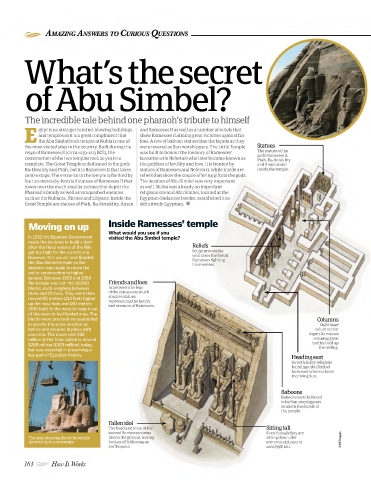
               gypt is no stranger to mind-blowing buildings   and Ramesses II as well as a number of reliefs that
               and temples so it is a great compliment that   show Ramesses claiming great victories against his
          Ethe Abu Simbel rock temple at Nubia is one of   foes. A row of baboon statues line the façade as they
          the most visited sites in the country. Built during the   were revered as Sun worshippers. The Little Temple   Statues
          reign of Ramesses II (circa 1279-1213 BCE), the   was built to honour the memory of Ramesses’   The statues of the
                                                                                           gods Ramesses II,
          construction of the two temples took 20 years to   favourite wife Nefertari who later became known as   Ptah, Ra-Horakhty
          complete. The Great Temple is dedicated to the gods   the goddess of fertility and love. It is fronted by   and Amun stand
          Ra-Horakty and Ptah, but it is Ramesses II that takes   statues of Ramesses and Nefertari, while inside are   inside the temple.
          centre stage. The entrance to the temple is flanked by   reliefs that show the couple offering gifts to the gods.
          four 20-metre (65-foot) tall statues of Ramesses II that   The location of Abu Simbel was very important
          tower over the much smaller statues that depict the   as well. Nubia was already an important
          Pharoah’s family as well as vanquished enemies   religious site and Abu Simbel, located at the
          such as the Nubians, Hittites and Libyans. Inside the   Egyptian-Sudanese border, established it as
          Great Temple are statues of Ptah, Ra-Horakhty, Amun   definitively Egyptian.


           Moving on up                Inside Ramesses’ temple
                                       What would you see if you
           In 1952 the Egyptian Government   visited the Abu Simbel temple?
           made the decision to build a dam
           after the flood waters of the Nile                         Reliefs
           got too high for the current one.                         Sculptures on the
           However, this would have flooded                           wall show the heroic
                                                                     Ramesses fighting
           the Abu Simbel temple so the                              his enemies.
           decision was made to move the
           entire construction to higher
           ground. Between 1963 and 1968
           the temple was cut into 10,000   Friends and foes
           blocks, each weighing between   In between the legs
           three and 20 tons. They were then   of the statues are much
           moved 65 metres (213 feet) higher   smaller statues
                                       representing the family
           up the mountain and 180 metres   and enemies of Ramesses.
           (600 feet) to the west to keep it out
           of the soon-to-be-flooded area. The
           blocks were precisely re-assembled                                                                    Columns
           in exactly the same position as                                                                       Eight huge
           before and secured in place with                                                                     columns that
           concrete. The move cost $42                                                                        depict Ramesses
           million at the time, which is around                                                                winning great
           $288 million (£183 million) today,                                                                  battles hold up
           but was essential in preserving a                                                                     the ceiling.
           key part of Egyptian history.
                                                                                                        Heading east
                                                                                                        As with many religious
                                                                                                        buildings Abu Simbel
                                                                                                        faces east where is faces
                                                                                                        the rising Sun.

                                                                                                    Baboons
                                                                                                    Baboons were believed
                                                                                                    to be Sun-worshippers
                                                                                                    so adorn the façade of
                                                                                                    the temple.
                                       Fallen idol
                                       The head and torso of the                               Sitting tall
                                       second Ramesses statue                                  Even though they are
           The task of moving the entire temple   lies on the ground, having                   sitting down, the
           involved up to 3,000 people  broken off following an                                entrance statues are      © DK Images
                                       earthquake.                                             20m (65ft) tall.

          164       How It Works

