


Page 161 - How It Works - Book Of Amazing Answers To Curious Questions, Volume 05-15
P. 161
History


            How have fridges evolved?


            The ingenious methods humans have used to keep food cool

            1                                                                        3


                                                            2

             1700 BCE          1400 BCE            400 BCE            1805               1748              1920s


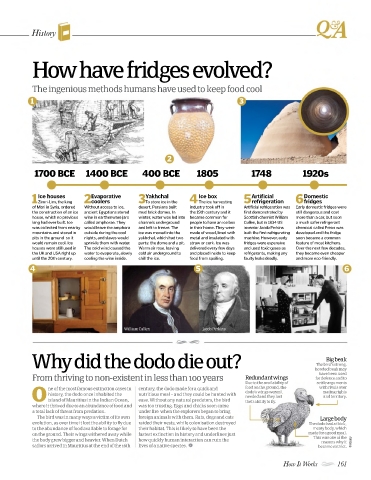
              Ice houses         Evaporative        Yakhchal           Ice box           Artifi cial         Domestic
            1 imri-Lim, the king  2 coolers       3 o store ice in the  4 he ice harvesting  5 refrigeration  6 fridges
                                                    T
              Z
                                                                       T
            of Mari in Syria, ordered   Without access to ice,   desert, Persians built   industry took off in   Artificial refrigeration was   Early domestic fridges were


            the construction of an ice   ancient Egyptians stored   mud brick domes. In   the 19th century and it   first demonstrated by   still dangerous and cost
            house, which no previous   wine in earthenware jars   winter, water was led into  became common for   Scottish chemist William   more than a car, but soon
            king had ever built. Ice   called amphorae. They   channels underground   people to have an ice box   Cullen, but in 1834 US   a much safer refrigerant
            was collected from nearby  would leave the amphora   and left to freeze. The   in their home. They were   inventor Jacob Perkins   chemical called Freon was
            mountains and stored in   outside during the cool   ice was moved into the   made of wood, lined with   built the fi rst refrigerating   developed and the fridge
            pits in the ground  so it   nights, and slaves would   yakhchal, which had two   metal and insulated with   machine. However, early   soon became a common
            would remain cool. Ice   sprinkle them with water.   parts: the dome and a pit.  straw or cork. Ice was   fridges were expensive   feature of most kitchens.
            houses were still used in   The cold wind caused the   Warm air rose, leaving   delivered every few days   and used toxic gases as   Over the next few decades,
            the UK and USA right up   water to evaporate, slowly   cold air underground to   and placed inside to keep   refrigerants, making any   they became even cheaper
            until the 20th century.  cooling the wine inside.  chill the ice.   food from spoiling.  faulty leaks deadly.  and more eco-friendly.
            4                                                         5                                                   6


                                             William Cullen             Jacob Perkins


            Why did the dodo die out?                                                                           The bird’s strong,
                                                                                                                    Big beak
                                                                                                                hooded beak may
                                                                                                                 have been used
            From thriving to non-existent in less than 100 years                       Redundant wings          for defence and to
                                                                                       Due to the availability of   settle arguments
                  ne of the most famous extinction cases in   century, the dodo made for a quick and   food on the ground, the   with rivals over
                  history, the dodo once inhabited the   nutritious meal – and they could be hunted with   dodo’s wings weren’t   mating rights
                                                                                       needed and they lost
                                                                                                                   and territory.
            Oisland of Mauritius in the Indian Ocean,   ease. Without any natural predators, the bird   their ability to fl y.
            where it thrived due to an abundance of food and   was too trusting. Eggs and chicks soon came
            a total lack of threat from predation.   under fire  when the explorers began to bring

              The bird was in many ways a victim of its own   foreign animals with them. Rats, dogs and cats      Large body
            evolution, as over time it lost the ability to fl y due   raided their nests, while colonisation destroyed   The dodo had a thick,
            to the abundance of food available to forage for   their habitat. This is likely to have been the   meaty body, which
            on the ground. Their wings withered away while   fastest extinction in history and underlines just   made for a good meal.
                                                                                                               This was one of the
            the body grew bigger and heavier. When Dutch   how quickly human interaction can ruin the
                                                                                                                  reasons why it   © Alamy
            sailors arrived in Mauritius at the end of the 16th   lives of a native species.                     became extinct.
                                                                                                     How It Works        161

