


Page 165 - How It Works - Book Of Amazing Answers To Curious Questions, Volume 05-15
P. 165
History


            Who were USA’s


            fi      rst            fi      remen? put the fi ght in fi                                    refi  ghter
                                                                                How the USA’s volunteers


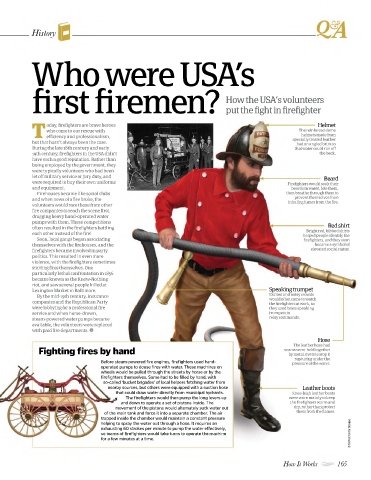
                 oday, fi refighters are brave heroes                                                              Helmet

                 who come to our rescue with                                                              The reinforced dome
                                                                                                           helmets made from
            Tefficiency and professionalism,                                                             specially treated leather

            but that hasn’t always been the case.                                                        had an angled brim so
            During the late 18th century and early                                                       that water could run off
            19th century, fi refighters in the USA didn’t                                                          the back.

            have such a good reputation. Rather than
            being employed by the government, they
            were typically volunteers who had been
            let off military service or jury duty, and                                                             Beard
            were required to buy their own uniforms                                                   Firefighters would soak their

            and equipment.                                                                             beards in water, bite them,
              Firehouses became like social clubs                                                     then breathe through them to
                                                                                                         prevent themselves from
            and when news of a fire broke, the                                                         inhaling fumes from the fi re.

            volunteers would race those from other
            fire companies to reach the scene fi rst,

            dragging heavy hand-operated water
            pumps with them. These competitions
                                                                                                                    Red shirt
            often resulted in the fi refi ghters battling                                                      Bright red, bibbed shirts
            each other instead of the fi re!                                                                 helped people identify the
              Soon, local gangs began associating                                                           fi refighters, and they soon

            themselves with the firehouses, and the                                                              became a symbol of

            fi refighters became involved in party                                                              elevated social status.

            politics. This resulted in even more
            violence, with the fi refi ghters sometimes

            starting fires themselves. One
            particularly lethal confrontation in 1856
            became known as the Know-Nothing
            riot, and saw several people killed at
            Lexington Market in Baltimore.                                                      Speaking trumpet
              By the mid-19th century, insurance                                                Excited and noisy crowds
            companies and the Republican Party                                                  would often come to watch

                                                                                                the fi refighters at work, so
            were lobbying for a professional fi re                                               they used brass speaking
            service and when horse-drawn,                                                       trumpets to
            steam-powered water pumps became                                                    relay commands.
            available, the volunteers were replaced
            with paid fi re departments.
                                                                                                                 Hose
                                                                                                        The leather hose had

               Fighting fires by hand                                                                 seams were  held together
                                                                                                      by metal rivets to stop it
                                                                                                         rupturing under the
                                    Before steam-powered fire engines, fi refighters used hand-            pressure of the water.


                                    operated pumps to douse fires with water. These machines on
                                    wheels would be pulled through the streets by horse or by the
                                    fi refighters themselves. Some had to be filled by hand, with


                                     so-called ‘bucket brigades’ of local helpers fetching water from
                                       nearby sources, but others were equipped with a suction hose        Leather boots
                                          that could draw water directly from municipal hydrants.       Knee-high leather boots
                                             The fi refighters would then pump the long levers up        were worn mainly to keep


                                           and down to operate a set of pistons inside. The            the fi refighters warm and
                                         movement of the pistons would alternately suck water out       dry, rather than protect
                                      of the main tank and force it into a separate chamber. The air     them from the fl ames.
                                    trapped inside the chamber would maintain a constant pressure
                                    helping to spray the water out through a hose. It requires an
                                    exhausting 60 strokes per minute to pump the water effectively,

                                    so teams of fi refighters would take turns to operate the machine                         © Corbis; Getty Images
                                    for a few minutes at a time.
                                                                                                     How It Works        165

