


Page 166 - How It Works - Book Of Amazing Answers To Curious Questions, Volume 05-15
P. 166
What                         were                      armoured


          trains?                             Discover how railways went to war


                                              in the 19th and 20th century

               he explosion of rail travel in the 19th
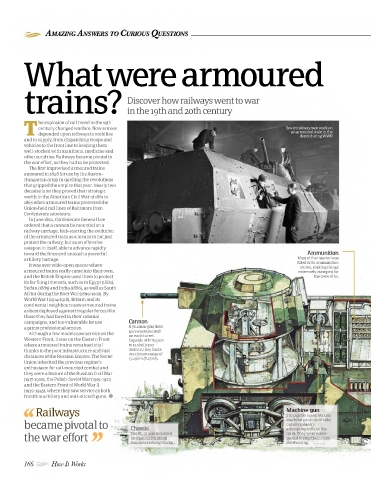
               century changed warfare. Now armies                                                    Soviet railwaymen work on
         Tdepended upon railways to mobilise                                                           an armoured train in the
                                                                                                          depot during WWII
          and to supply, from dispatching troops and
          vehicles to the front line to keeping them
          well-stocked with munitions, medicine and
          other sundries. Railways became pivotal to
          the war effort, so they had to be protected.
           The first improvised armoured trains

          appeared in 1848 for use by the Austro-
          Hungarian army in quelling the revolutions
          that gripped the empire that year. Nearly two
          decades later they proved their strategic
          worth in the American Civil War of 1861 to
          1865 when armoured trains protected the
          Union-held rail lines of Baltimore from
          Confederate saboteurs.
           In June 1862, Confederate General Lee
          ordered that a cannon be mounted on a
          railway carriage, kick-starting the evolution
          of the armoured train as a means to not just
          protect the railway, but as an offensive
          weapon in itself, able to advance rapidly
          toward the lines and unleash a powerful                                                            Ammunition
                                                                                                          Most of the interior was
          artillery barrage.                                                                             filled with ammunition

           It was over wide-open spaces where                                                              stores, making things
          armoured trains really came into their own,                                                     extremely cramped for
          and the British Empire used them to protect                                                          the crew of 30.

          its far-flung interests, such as in Egypt (1882),
          Sudan (1885) and India (1886), as well as South
          Africa during the Boer War (1899-1902). By
          World War I (1914-1918), Britain and its
          continental neighbours saw armoured trains
          as best deployed against irregular forces like
          those they had faced in their colonial
          campaigns, and too vulnerable for use   Cannon
          against professional armies.        A 76.2mm (3in) fi eld
                                              gun was mounted
           Although a few models saw service on the   on each turret.
          Western Front, it was on the Eastern Front   Capable of fi ring ten
          where armoured trains remained vital   to 12 shells per
          thanks to the poor infrastructure and vast   minute, they had a
                                              maximum range of
          distances of the Russian Empire. The Soviet   13.29km (8.25mi).
          Union inherited the previous regime’s
          enthusiasm for rail-mounted combat and
          they were a feature of the Russian Civil War
          (1917-1920), the Polish-Soviet War (1919-1921)
          and the Eastern Front of World War II
          (1939-1945), where they saw service as both
          frontline artillery and anti-aircraft guns.

              Railways
              Ra  i l wa ys
         became pivotal to

         the war effort


          166       How It Works

