


Page 85 - History of War - Issue 05-14
P. 85
Hand grenade


               The first example of hand-thrown incendiary devices dates
               back to Byzantine soldiers in the 8th century. The original
               devices were stone or ceramic jars containing “Greek Fire” – a
               combination of various chemicals, including naphtha, sulphur,
               pine resin and quicklime. The device was wrapped in a burning
               cloth, and thrown. The container shattered on impact, and is
               contents would ignite, spreading sticky burning fluids.
                Naturally the first explosive devices can be traced back
               to China in the 10th century, where small containers were
               crammed with gunpowder and detonated by a lit fuse. These
               were called Zhen Tian Lei – or “Sky-Shaking Thunder”.
                Europe caught on to the idea in the 1600s, when the term
               “grenade” was coined during the war between King James II
               of England and forces led by William of Orange. However the
               weapon wouldn’t prove its worth until the Crimean War, where
               its effectiveness in trench warfare became evident.
                The hand grenade as we know it today was first patented
               by Nils Waltersen Aasen of Norway in 1906. By the outbreak
               of WWI, he had 13 factories with 13,000 workers churning
               out grenades for French Army (the diagrams opposite are
               from the French Platoon Leader’s Manual of 1917, showing
               the correct method for launching a grenade at the enemy).


              nicknamed “Tickler’s Artillery” after a well-known
              jam manufacturer – that predominated, which
              consisted of a tin can, packed with dynamite or
              gun cotton, with a detonator attached to a fuse
              that projected through the top. Fragmentation   delivered in wooden boxes of 30. Battye was
              could be improved by adding pieces of scrap   also celebrated for his efforts in bringing electric   groups of grenadiers worked together would it
              metal or fragments of barbed wire.    lighting and heating to dugouts.       be possible to develop new tactics, and this had
               Notes From the Front recommended practice   The so-called “Mexican” grenade – later known   commenced by the beginning of 1915. In Notes
              with dummy bombs, and testing of fuses to   as the “No 2” – was a type of British explode-on-  on Attack and Defence it was recommended
              determine burn time. Fuses were to be long   impact stick grenade seen in small numbers. Its   that attacks should always be well supplied with
              enough that the bomb could be thrown, but not   strange name came about because it was being   bombs, and that there should be “an organised
              so long that an alert enemy could dive into cover   produced for a commercial contract for Mexico   plan” to keep the defenders “of a captured
              or even hurl the missile back. Jam Tins were   by the Cotton Powder Company of Faversham in   trench amply supplied with these missiles”.
              made in many different places, but one of the   Kent at the outbreak of war.   By May 1915 an ideal “Trench Storming Party”
              earliest venues that could claim the title “factory”   Though Feld-Pionierdienst had envisaged   had been devised by the British. This was to
              was the village of Gorre behind the Givenchy-  that grenades would be used in the clearance   comprise upwards of 14 men commanded by
              Festubert sector where the sappers and miners   of fieldworks, quite how the grenadier would   an NCO. The men of the party would be divided
              of the Indian Meerut Division were ensconced   achieve this in practice was not immediately   into four distinct tasks: “bayonet men” to cover
              from November 1914.                   apparent. Grenades were quickly used in raids,   the group and take the lead in winkling out the
                                                    and grenadiers were put in the front line ahead   opposition; grenadiers; grenade carriers; and
              Hairbrush grenade                     of attacking infantry. Another tactic used at a   “sandbag men” whose duty was to follow up,
              According to Notes From the Front the British   very early stage was to open rapid fire with other   block side entrances, and finally form a barricade
              improvised “Hairbrush” was about 20 inches   weapons, so allowing bomb throwers to creep   in the trench at the furthest point of the advance.
              in length, with a slab of explosive surrounded   forward: but none of these methods yet exploited   To provide manpower for these storming parties
              by metal fragments within a sacking cover,   the grenade to its fullest potential. Only when   the “very best, bravest and steadiest in an
              attached to the wooden handle, again with a
              fuse and detonator. An Imperial War Museum
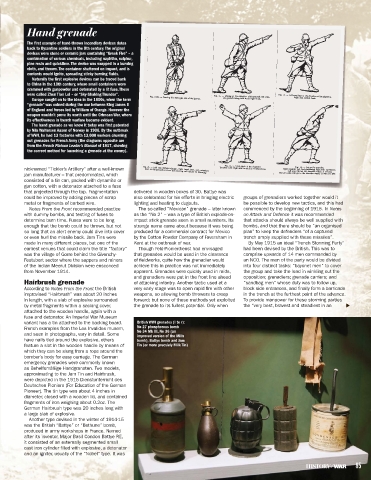
              variant has a tin attached to the backing board.   British WWI grenades (l to r):
              French examples from the Les Invalides musem,   No 27 phosphorous bomb
                                                     No 34 Mk III, No 36 (an
              and seen in photographs, vary in detail. Some   improved version of the Mills
              have nails tied around the explosive, others   bomb), Battye bomb and Jam
              feature a slot in the wooden handle by means of   Tin (or more precsiely Milk Tin)
              which they can be slung from a rope around the
              bomber’s body for easy carriage. The German
              emergency grenades were commonly known
              as Behelfsmäßige Handgranaten. Two models,
              approximating to the Jam Tin and Hairbrush,
              were depicted in the 1915 Dienstunterricht des
              Deutschen Pioniers (For Education of the German
              Pioneer). The tin type was about 4 inches in
              diameter, closed with a wooden lid, and contained
              fragments of iron weighing about 0.2oz. The
              German Hairbrush type was 20 inches long with
              a large slab of explosive.
               Another type devised in the winter of 1914-15
              was the British “Battye” or “Bethune” bomb,
              produced in army workshops in France. Named
              after its inventor, Major Basil Condon Battye RE,
              it consisted of an externally segmented small
              cast iron cylinder filled with explosive, a detonator
              and an igniter, usually of the “Nobel” type. It was
                                                                                                                 HISTORY  WAR    85
                                                                                                                         of

