


Page 84 - History of War - Issue 05-14
P. 84
TRENCH WARFARE


              side clear peak casualty figures were reached
              from August to November 1914, and again from
              March 1918 to the end of the war. French losses
              were at their worst in 1914 and British losses in
              July 1916 were catastrophic. British forces also
              experienced heavy losses from August to October
              1918. Covering the approach of the attacker
              could mean one of two things: concealing him
              from view, or physically protecting him from the
              enemy’s bullets. Of these, concealment from view
              proved easily the most useful – night raids and
              attack around dawn or dusk were soon common,
              and smoke and fog were both used.
               The German manual Feld-Pionierdienst (Field
              Pioneer Service) also suggests that advancing
              troops could carry filled sandbags with them,
              preferably under cover of darkness, and throw
              up a small breastwork as the first stage of
              cover. Metal shields were used early in the war,
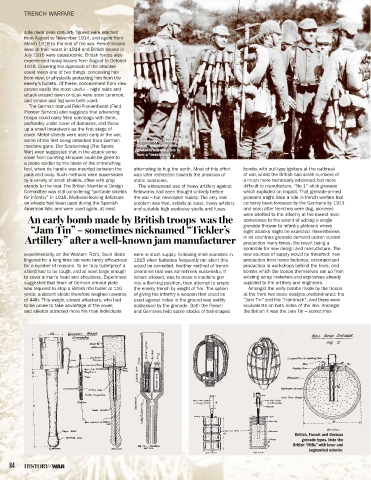
              some of the first being detached from German   A Stosstrupp or “Assault
              machine guns. Der Spatenkrieg (The Spade   Squad” armed with stick
              War) even suggested that in the attack some   grenades and materials to
              cover from bursting shrapnel could be given to   form a “trench block”.
              a prone soldier by the blade of the entrenching
              tool, when its handle was inserted between the   attempting to hug the earth. Most of this effort   bombs with pull-type igniters at the outbreak
              pack and body. Such methods were superseded   was later redirected towards the provision of   of war, whilst the British had small numbers of
              by a variety of small shields, often with prop   static loopholes.           a much more technically advanced, but more
              stands to the rear. The British Munitions Design   The widespread use of heavy artillery against   difficult to manufacture, “No 1” stick grenade
              Committee was still considering “portable shields   fieldworks had been thought unlikely before   which exploded on impact. That grenade-armed
              for infantry” in 1916. Medieval-looking defences   the war – but developed rapidly. The only real   pioneers might have a role in trench warfare had
              on wheels had been used during the Spanish-  problem was that, initially at least, heavy artillery   certainly been foreseen by the Germans by 1911
              American War, and were used again, at least   and suitable high explosive shells and fuses   and soon after trenches were dug, pioneers
               An early bomb made by British troops  was the                               were allotted to the infantry at the lowest level,
                                                                                           sometimes to the extent of adding a single
                “Jam Tin” – sometimes nicknamed “Tickler’s                                 grenade thrower to infantry platoons where
                                                                                           night attacks might be expected. Nevertheless
              Artillery” after a well-known jam manufacturer                               in all countries grenade demand outran current
                                                                                           production many times, the result being a
                                                                                           scramble for new design and manufacture. The
              experimentally, on the Western Front. Such ideas   were in short supply. Following shell scandals in   new sources of supply would be threefold: new
              lingered for a long time but were rarely efficacious   1915 when batteries frequently ran short this   production from home factories; extemporised
              for a number of reasons. To be truly bulletproof a   would be corrected. Another method of trench   production in workshops behind the lines; and
              shield had to be tough, and at least large enough   clearance that was sometimes successful, if   bombs which the troops themselves ran up from
              to cover a man’s head and shoulders. Experiment   terrain allowed, was to move a machine gun   existing scrap materials and explosives already
              suggested that 5mm of German armour plate   into a flanking position, then attempt to empty   supplied to the artillery and engineers.
              was required to stop a British rifle bullet at 110   the enemy trench by weight of fire. The option   Amongst the early bombs made by the troops
              yards: a decent shield therefore weighed upwards   of giving the infantry a weapon that could be   at the front two basic designs predominated: the
              of 44lb. This weight slowed attackers, who had   used against holes in the ground was swiftly   “Jam Tin” and the “Hairbrush”, and there were
              to be prone to take advantage of the cover,   addressed by the grenade. Both the French   equivalents on both sides of the line. Amongst
              and shields attracted more fire than individuals   and Germans held some stocks of ball-shaped   the British it was the Jam Tin – sometimes


                                                                                                             British, French and German
                                                                                                               grenade types. Note the
                                                                                                            British “Mills” with lever and
                                                                                                                  segmented exterior.

        84    HISTORY  WAR
                      of

