


Page 83 - History of War - Issue 05-14
P. 83
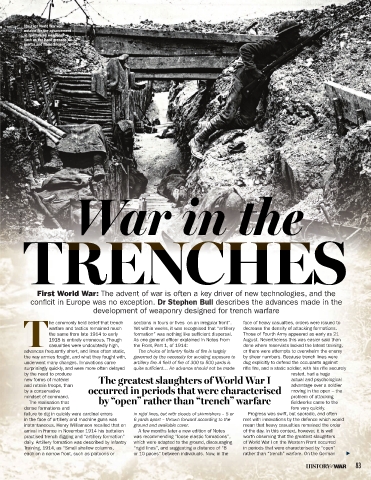
The First World War was
              notable for the advancement
              of specialised weapons,
              such as the hand grenade,
              mortar and flamethrower


                               War in the


             Rex Features

                                                                      C
              TRENCHES
              T            R              EN                                        H                ES


                  First World War: The advent of war is often a key driver of new technologies, and the
                conflcit in Europe was no exception. Dr Stephen Bull describes the advances made in the
                                      development of weaponry designed for trench warfare

                      he commonly held belief that trench   sections in fours or fives  on an irregular front”.   face of heavy casualties, orders were issued to
                      warfare and tactics remained much   Yet within weeks, it was recognised that “artillery   decrease the density of attacking formations.
                      the same from late 1914 to early   formation” was nothing like sufficient dispersal.   Those of Fourth Army appeared as early as 21
                      1918 is entirely erroneous. Though   As one general officer explained in Notes From   August. Nevertheless this was easier said than
              T casualties were undoubtedly high,   the Front, Part 1, of 1914:            done where reservists lacked the latest training,
              advances frequently short, and lines often static,   The choice of infantry fields of fire is largely   or there were attempts to overwhelm the enemy
              the way armies fought, and what they fought with,   governed by the necessity for avoiding exposure to   by sheer numbers. Because trench lines were
              underwent many changes. Innovations came   artillery fire. A field of fire of 300 to 500 yards is   dug explicitly to defend the occupants against
              surprisingly quickly, and were more often delayed   quite sufficient… An advance should not be made   rifle fire, and a static soldier, with his rifle securely
              by the need to produce                                                                        rested, had a huge
              new forms of matériel     The greatest slaughters of World War I                              actual and psychological
              and retrain troops, than                                                                      advantage over a soldier
              by a conservative     occurred in periods that were characterised                             moving in the open – the
              mindset of command.       by “open” rather than “trench” warfare                              problem of attacking
               The realisation that                                                                         fieldworks came to the
              dense formations and                                                                          fore very quickly.
              failure to dig in quickly were cardinal errors   in rigid lines, but with clouds of skirmishers – 5 or   Progress was swift, but sporadic, and often
              in the face of artillery and machine guns was   6 yards apart – thrown forward according to the   met with innovations by the defence which would
              instantaneous. Henry Williamson recalled that on   ground and available cover.  mean that heavy casualties remained the order
              arrival in France in November 1914 his battalion   A few months later a new edition of Notes   of the day. In this context, however, it is well
              practised trench digging and “artillery formation”   was recommending “loose elastic formations”,   worth observing that the greatest slaughters
              daily. Artillery formation was described by Infantry   which were adapted to the ground, discouraging   of World War I on the Western Front occurred
              Training, 1914, as “Small shallow columns,   “rigid lines”, and suggesting a distance of “8   in periods that were characterised by “open”
              each on a narrow front, such as platoons or   or 10 paces” between individuals. Now, in the   rather than “trench” warfare. On the German
                                                                                                                 HISTORY  WAR    83
                                                                                                                         of

