


Page 86 - History of War - Issue 05-14
P. 86
TRENCH WARFARE
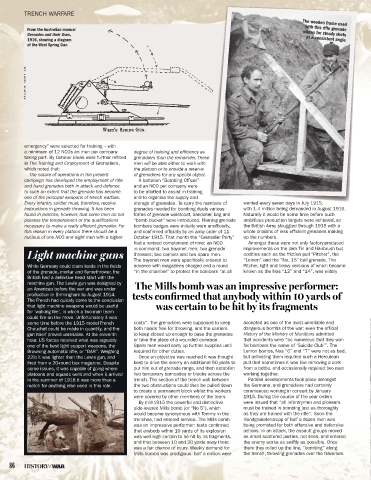
                                                                                                                The wooden frame used
               From the Australian manual                                                                        with this rifle grenade
               Grenades and their Uses,                                                                         allows for steady shots
               1916, showing a diagram                                                                           at a consistent angle
               of the West Spring Gun


              emergency” were selected for training – with
              a minimum of 12 NCOs an men per company   degree of training and efficiency as
              taking part. By October ideas were further refined   grenadiers than the remainder. These
              in The Training and Employment of Grenadiers,   men will be able either to work with
              which noted that:                     the platoon or to provide a reserve
               The nature of operations in the present   of grenadiers for any special object.
              campaign has developed the employment of rifle   A battalion “Bombing Officer”
              and hand grenades both in attack and defence   and an NCO per company were
              to such an extent that the grenade has become   to be allotted to assist in training
              one of the principal weapons of trench warfare.   and to organise the supply and
              Every infantry soldier must, therefore, receive   storage of grenades. To carry the numbers of   wanted every seven days in July 1915,
              instructions in grenade throwing. It has been   grenades needed for bombing duels various   with 1.4 million being demanded in August 1916.
              found in practice, however, that some men do not   forms of grenade waistcoat, bandolier, bag and   Naturally it would be some time before such
              possess the temperament or the qualifications   “bomb bucket” were introduced. Flaming grenade   ambitious production targets were achieved, so
              necessary to make a really efficient grenadier. For   bombers badges were initially worn unofficially,   the British Army struggled through 1915 with a
              this reason in every platoon there should be a   and confirmed officially by an army order of 11   whole phalanx of less efficient grenades making
              nucleus of one NCO and eight men with a higher   October 1915. That month the “Grenadier Party”   up the numbers.
                                                    had a revised complement of nine: an NCO   Amongst these were not only factory-produced
                                                    in command; two bayonet men; two grenade   improvements on the Jam Tin and Hairbrush but
               Light machine guns                   throwers; two carriers and two spare men.   oddities such as the friction pull “Pitcher”, the
                                                    The bayonet men were specifically ordered to   “Lemon” and the “No. 15” ball grenade. The
               While Germany could claim leads in the fields   advance with magazines charged and a round   Pitcher, light and heavy versions of which became
               of the grenade, mortar and flamethrower, the   “in the chamber” to protect the bombers “at all   known as the Nos “13” and “14”, was widely
               British had a definitive head start with the
               machine gun. The Lewis gun was designed by   The Mills bomb was an impressive performer:
               an American before the war and was under
               production in Birmingham by August 1914.   tests confirmed that anybody within 10 yards of
               The French had quickly come to the conclusion
               that light machine weapons would be useful   was certain to be hit by its fragments
               for ‘walking fire’, in which a two-man team
               could fire on the move. Unfortunately it was
               some time before the 1915 model French   costs”. The grenadiers were supposed to keep   accepted as one of the most unreliable and
               Chauchat could be made in quantity, and the   both hands free for throwing, and the carriers   dangerous bombs of the war: even the official
               gun itself proved unreliable. At the eleventh   to keep closed up enough to pass the grenades   History of the Ministry of Munitions admitted
               hour, US forces received what was arguably   or take the place of a wounded comrade.   that accidents were “so numerous that they won
               one of the best light support weapons, the   Spare men would carry up further supplies until   for bombers the name of ‘Suicide Club’”. The
               Browning automatic rifle, or “BAR”. Weighing   required for other duties.    Lemon bombs, Nos “6” and “7” were not as bad,
               22lb it was lighter than the Lewis gun, and   Once an objective was reached it was thought   but activating them required such a Herculean
               fired from a 20-round box magazine. Despite   best to drive the enemy an additional 50 yards to   pull that sometimes it was like removing a cork
               some issues, it was capable of going where   put him out of grenade range, and then establish   from a bottle, and occasionally required two men
               platoons and squads went and when it arrived   two temporary barricades or blocks across the   working together.
               in the summer of 1918 it was more than a   trench. The section of the trench wall between   Parallel developments took place amongst
               match for anything else used in this role.  the two obstructions could then be pulled down   the Germans, and grenadiers had certainly
                                                    to create a permanent block whilst the workers   commenced working in concert by January
                                                    were covered by other members of the team.  1915. During the course of the year orders
                                                      By mid-1915 the powerful and distinctive   were issued that “all infantrymen and pioneers
                                                    side-levered Mills bomb (or “No 5”), which   must be trained in bombing just as thoroughly
                                                    would become synonymous with Tommy in the   as they are trained with the rifle”. Soon the
                                                    trenches, had entered service. The Mills bomb   Handgranatentrupp of half a dozen men was
                                                    was an impressive performer: tests confirmed   being promoted for both offensive and defensive
                                                    that anybody within 10 yards of its explosion   actions. In an attack, the assault groups moved
                                                    was well nigh certain to be hit by its fragments,   as small scattered parties, not lines, and entered
                                                    and that between 10 and 20 yards away there   the enemy works as swiftly as possible. Once
                                                    was a fair chance of injury. Weekly demand for   there they rolled up the line, “bombing” along
                                                    Mills bombs was prodigious: half a million were   the trench, throwing grenades over the traverses
        86  86   HISTORY  WAR

               ISTO
                     Y
                    R
              H
                           R
                       WA
                      of of

