


Page 87 - History of War - Issue 05-14
P. 87
and forming “blocks” using sandbags, shields,
              spades and anything else that members of the
              party carried with them. On the defence the
              Handgranatentrupp went into action immediately
              and unbidden by higher authority, as was
              illustrated by orders issued to 235th Reserve
              Infantry in December 1915:
               All men of the party carry their rifles slung,
              bayonets fixed and daggers ready, with the
              exception of the two leaders, who do not carry
              rifles. The latter may carry as many grenades
              as they can conveniently handle and should if
              possible be armed with pistols. The commander,
              similarly armed, follows the two leading men…
              The remaining three men follow the others one
              traverse to the rear; they keep within sight of
              their commander, and carry as many grenades
              as possible. The two leading men advance along
              the trench in a crouching posture, so that the
              commander can fire over them. The interval
              between traverses is crossed at a rush.
               By early 1916 the Handgranatentrupp was
              further refined so that it comprised eight men
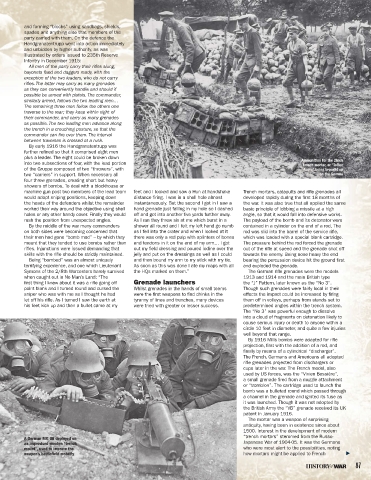
              plus a leader. The eight could be broken down                                                    Ammunition for the 2inch
              into two subsections of four, with the lead portion                                               trench mortar, or “Toffee
              of the Gruppe composed of two “throwers”, with                                                    Apple” being brought up
              two “carriers” in support. When necessary all                                                           on the Somme
              four threw grenades, creating short but heavy
              showers of bombs. To deal with a blockhouse or
              machine gun post two members of the lead team   feet and I looked and saw a Hun at handshake   Trench mortars, catapults and rifle grenades all
              would adopt sniping positions, keeping down   distance firing. I was in a shell hole almost   developed rapidly during the first 18 months of
              the heads of the defenders whilst the remainder   instantaneously. But the second I got in I saw a   the war. It was also true that all applied the same
              worked their way around the objective using shell   hand grenade just falling in my hole so I dashed   basic principle of lobbing a missile at a high
              holes or any other handy cover. Finally they would   off and got into another five yards further away.   angle, so that it would fall into defensive works.
              rush the position from unexpected angles.  As I ran they threw six at me which burst in a   The payload of the bomb and its detonator were
               By the middle of the war many commanders   shower all round and I felt my left hand go numb   contained in a cylinder on the end of a rod. The
              on both sides were becoming concerned that   as I fell into the crater and when I looked at it   rod was slid into the barrel of the service rifle,
              their men had gone “bomb mad” – by which they   there was only a red pulp with splinters of bones   which was loaded with a special blank cartridge.
              meant that they tended to use bombs rather than   and tendons in it on the end of my arm… I got   The pressure behind the rod forced the grenade
              rifles. Injunctions were issued demanding that   out my field dressing and poured iodine over the   out of the rifle at speed and the grenade shot off
              skills with the rifle should be strictly maintained.  jelly and put on the dressings as well as I could   towards the enemy. Being nose heavy the end
               Being “bombed” was an almost uniquely   and then bound my arm to my stick with my tie.   bearing the percussion device hit the ground first
              terrifying experience, and one which Lieutenant   As soon as this was done I ate my maps with all   and exploded the grenade.
              Symons of the 2/8th Worcesters barely survived   the HQs marked on them.”      The German rifle grenades were the models
              when caught out in No Man’s Land: “The                                       1913 and 1914 and the main British type
              first thing I knew about it was a rifle going off   Grenade launchers          the “J” Pattern, later known as the “No 3”.
              point blank and I turned round and cursed the   Whilst grenades in the hands of small teams   Though such grenades were fairly local in their
              sniper who was with me as I thought he had   were the first weapons to find chinks in the   effects the impact could be increased by firing
              let off his rifle. As I turned I saw the earth at   tyranny of lines and trenches, many devices   them off in volleys, perhaps from stands set to
              his feet kick up and then a bullet came at my   were tried with greater or lesser success.   predetermined angles within the trench system.
                                                                                           The “No 3” was powerful enough to dissolve
                                                                                           into a cloud of fragments on detonation likely to
                                                                                           cause serious injury or death to anyone within a
                                                                                           circle 10 feet in diameter, and quite a few injuries
                                                                                           well beyond that range.
                                                                                             By 1916 Mills bombs were adapted for rifle
                                                                                           projection, first with the addition of a rod, and
                                                                                           finally by means of a cylindrical “discharger”.
                                                                                           The French, Germans and Americans all adopted
                                                                                           rifle grenades projected from dischargers or
                                                                                           cups later in the war. The French model, also
                                                                                           used by US forces, was the “Vivien Bessière”,
                                                                                           a small grenade fired from a muzzle attachment
                                                                                           or “tromblon”. The cartridge used to launch the
                                                                                           bomb was a bulleted round which passed through
                                                                                           a channel in the grenade and ignited its fuse as
                                                                                           it was launched. Though it was not adopted by
                                                                                           the British Army the “VB” grenade received its UK
                                                                                           patent in January 1916.
                                                                                             The mortar was a weapon of surprising
                                                                                           antiquity, having been in existence since about
                                                                                           1500. Interest in the development of modern
              A German MG 08 deployed on                                                   “trench mortars” stemmed from the Russo-
              an improvised wooden “trench                                                 Japanese War of 1904-05. It was the Germans
              mount”, used to improve the                                                  who were most alert to the possibilities, noting
              weapon’s battlefield mobility                                                 how mortars might be applied to French

                                                                                                                 HISTORY  WAR          87  87
                                                                                                                           WA
                                                                                                                              R
                                                                                                                        Y
                                                                                                                  ISTO
                                                                                                                 H
                                                                                                                       R
                                                                                                                         of of

