


Page 88 - History of War - Issue 05-14
P. 88
TRENCH WARFARE

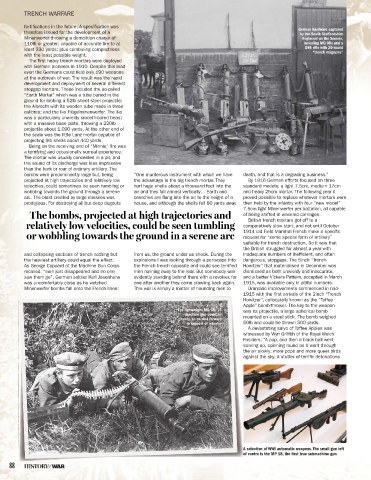
              fortifications in the future. A specification was                                                 German hardware captured
              therefore issued for the development of a                                                        by the South Staffordshire
              Minenwerfer throwing a demolition charge of                                                       Regiment on the Somme,
              110lb or greater; capable of accurate fire to at                                                   including MG 08s and a
              least 330 yards; plus combining compactness                                                       G98 rifle with 20-round
                                                                                                                   “trench magazine”
              with the least possible weight.
               The first heavy trench mortars were deployed
              with German pioneers in 1910. Despite this lead
              even the Germans could field only 190 weapons
              at the outbreak of war. The result was the rapid
              development and deployment of several different
              stopgap mortars. These included the so-called
              “Earth Mortar” which was a tube buried in the
              ground for lobbing a 52lb sheet steel projectile;
              the Albrecht with its wooden tube made in three
              calibres; and the Iko Flügelminenwerfer. The Iko
              was a particularly unwieldy smooth-bored beast
              with a massive base plate, throwing a 220lb
              projectile about 1,090 yards. At the other end of
              the scale was the little Lanz mortar capable of
              projecting 9lb shells about 440 yards.
               Being on the receiving end of “Minnie” fire was
              a terrifying and occasionally surreal experience.
              The mortar was usually concealed in a pit, and
              the sound of its discharge was less impressive
              than the bark or roar of ordinary artillery. The
              bombs were predominantly large but, being   “One murderous instrument with which we have   death, and that is a degrading business.”
              projected at high trajectories and relatively low   the advantage is the big trench mortar. They   By 1916 German efforts focused on three
              velocities, could sometimes be seen tumbling or   hurl huge shells about a thousand feet into the   standard models: a light 7.5cm, medium 17cm
              wobbling towards the ground through a serene   air and they fall almost vertically… Earth and   and heavy 25cm mortar. The following year it
              arc. The blast created by large missiles was   branches are flung into the air to the height of a   proved possible to replace whatever mortars were
              prodigious. For destroying all but deep dugouts   house, and although the shells fell 80 yards away   then held by the infantry with four “new model”
                                                                                           7.5cm light Minenwerfer per battalion, all capable
                The bombs, projected at high trajectories and                              of being shifted in wheeled carriages.
                                                                                             British trench mortars got off to a
              relatively low velocities, could be seen tumbling                            comparatively slow start, and not until October
               or wobbling towards the ground in a serene arc                              1914 did Field Marshal French make a specific
                                                                                           request for “some special form of artillery”
                                                                                           suitable for trench destruction. So it was that
                                                                                           the British struggled for almost a year with
              and collapsing sections of trench nothing but   from us, the ground under us shook. During the   inadequate numbers of inefficient, and often
              the heaviest artillery could equal the effect.   explosions I was looking through a periscope into   dangerous, stopgaps. The 5inch “Trench
              As George Coppard of the Machine Gun Corps   the French trench opposite and could see terrified   Howitzer” that materialised in December was
              recalled, “men just disappeared and no one   men running away to the rear. But somebody was   dismissed as both unwieldy and inaccurate,
              saw them go”. German soldier Karl Josenhans   evidently standing behind them with a revolver, for   and a better Vickers Pattern, accepted in March
              was uncomfortably close as he watched   one after another they came crawling back again.   1915, was available only in pitiful numbers.
              Minenwerfer bombs fall onto the French lines:   This war is simply a matter of hounding men to   Dramatic improvements commenced in mid-
                                                                                           1915 with the first arrivals of the 2inch “Trench
                                                                                           Howitzer”, colloquially known as the “Toffee
                                                                                           Apple” bomb-thrower. The key to the weapon
                                                                    The lightweight MG 08/15   was its projectile, a large spherical bomb
                                                                      machine gun could, in
                                                                    theory, be carried forward   mounted on a steel stick. The bomb weighed
                                                                       in support of infantry  50lb and could be thrown 500 yards.
                                                                                             A devastating salvo of Toffee Apples was
                                                                                           witnessed by Wyn Griffith of the Royal Welch
                                                                                           Fusiliers: “A pop, and then a black ball went
                                                                                           soaring up, spinning round as it went through
                                                                                           the air slowly; more pops and more queer birds
                                                                                           against the sky. A stutter of terrific detonations


                                                Getty
                                                                                           A selection of WWI automatic weapons. The small gun left
                                                                                           of centre is the MP 18, the first true submachine gun
        88    HISTORY  WAR
                      of

