


Page 90 - History of War - Issue 05-14
P. 90
TRENCH WARFARE

              a battery of steel springs. Downward pressure
              on a cocking lever by two or three men set the
              mechanism. It could be carried into position by
              stretcher-like handles, and required sandbags
              on its base to prevent it bucking crazily on
              discharge. Guy Chapman thought that the
              West was likely to decapitate its user, and its
              dangerous reputation was certainly confirmed by
              a November 1915 report in the 144th Brigade
              War Diary: Lieutenant Schwalm, 6th Glosters,
              Brigade Grenadier Officer, was killed whilst firing
              the West bomb thrower, his foot slipped and his
              head was hit by the arm of the machine, after
              the spring had been released. This is not the first
              accident which has occurred with this machine,
              a very cumbersome one from which the results
              obtained are no means commensurate with the
              dangers incurred by the user and the difficulty in
              manoeuvring it.
               Experimentation with the weird and wonderful
              continued even after the demise of the West
              and Leach. In June 1916 the Munitions Design
              Committee looked at a “Rotary Apparatus for
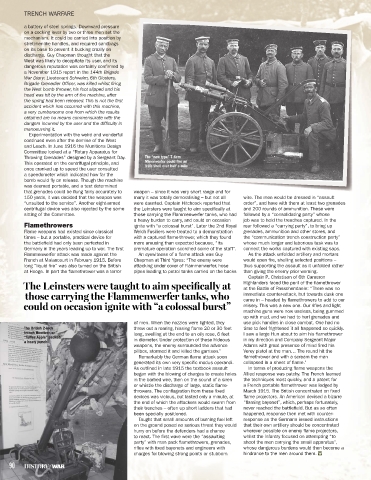
              Throwing Grenades” designed by a Sergeant Day.   The “new type” 7.6cm
              This operated on the centrifugal principle, and   Minenwerfer could fire an
              once cranked up to speed the user consulted   11lb shell over half a mile
              a speedometer which indicated how far the
              bomb would fly on release. Though the machine
              was deemed portable, and a test determined
              that grenades could be flung fairly accurately to   weapon – since it was very short range and for
              150 yards, it was decided that the weapon was   many it was totally demoralising – but not all   wire. The men would be dressed in “assault
              “unsuited to the service”. Another eight-armed   were daunted. Captain Hitchcock reported that   order”, and have with them at least two grenades
              centrifugal device was also rejected by the same   the Leinsters were taught to aim specifically at   and 200 rounds of ammunition. These were
              sitting of the Committee.             those carrying the Flammenwerfer tanks, who had   followed by a “consolidating party” whose
                                                    a heavy burden to carry, and could on occasion   job was to hold the trenches captured. In the
              Flamethrowers                         ignite with “a colossal burst”. Later the 2nd Royal   rear followed a “carrying party”, to bring up
              Flame weapons had existed since classical   Welch Fusiliers were treated to a demonstration   grenades, ammunition and other stores, and
              times – but a portable, practical device for   with a captured flame-thrower, which they found   the “communication trench construction party”
              the battlefield had only been perfected in   more amusing than expected because, “its   whose much longer and laborious task was to
              Germany in the years leading up to war. The first   premature operation scorched some of the staff”.  connect the works captured with existing saps.
              Flammenwerfer attack was made against the   An eyewitness of a flame attack was Guy   As the attack unfolded artillery and mortars
              French at Malancourt in February 1915. Before   Chapman at Third Ypres: “The enemy were   would open fire, shelling selected positions –
              long “liquid fire” was also turned on the British   attacking under cover of Flammenwerfer, hose   thus supporting the assault as it unfolded rather
              at Hooge. In part the flamethrower was a terror   pipes leading to petrol tanks carried on the backs   than giving the enemy prior warning.
                                                                                             Captain P. Christison of 6th Cameron
              The Leinsters were taught to aim specifically at                             Highlanders faced the peril of the flamethrower
                                                                                           at the Battle of Passchendaele: “There was no
              those carrying the Flammenwerfer tanks, who                                  immediate counter-attack, but towards dusk one
                                                                                           came in – headed by flamethrowers to add to our
              could on occasion ignite with “a colossal burst”                             misery. This was a new one. Our rifles and light
                                                                                           machine guns were now useless, being gummed
                                                                                           up with mud, and we had to hurl grenades and
                                                    of men. When the nozzles were lighted, they   use pick handles in close combat. One had no
              The British 2-inch                    threw out a roaring, hissing flame 20 or 30 feet   time to feel frightened it all happened so quickly.
              trench Howitzer, or                   long, swelling at the end to an oily rose, 6 feet   I saw a large Hun about to aim his flamethrower
              “Toffee Apple” packed                 in diameter. Under protection of these hideous   in my direction and Company Sergeant Major
              a heavy punch
                                                    weapons, the enemy surrounded the advance   Adams with great presence of mind fired his
                                                    pillbox, stormed it and killed the garrison.”  Verey pistol at the man… The round hit the
                                                      Remarkably the German flame attack soon   flamethrower and with a scream the man
                                                    generated its own very specific modus operandi.   collapsed in a sheet of flame.”
                                                    As outlined in late 1915 the textbook assault   In terms of producing flame weapons the
                                                    began with the blowing of charges to create holes   Allied response was patchy. The French learned
                                                    in the barbed wire, then on the sound of a siren   the techniques most quickly, and a patent for
                                                    or whistle the discharge of large, static flame-  a French portable flamethrower was lodged by
                                                    throwers. The conflagration from these fixed   March 1915. The British concentrated on fixed
                                                    devices was vicious, but lasted only a minute, at   flame projectors. An American devised a bizarre
                                                    the end of which the attackers would swarm from   “flaming bayonet”, which, perhaps fortunately,
                                                    their trenches – often up short ladders that had   never reached the battlefield. But as so often
                                                    been specially positioned.             happened, response then met with counter-
                                                      Taught that small amounts of burning fuel left   response as the Germans issued instructions
                                                    on the ground posed no serious threat they would   that their own artillery should be concentrated
                                                    hurry on before the defenders had a chance   wherever possible on enemy flame projectors,
                                                    to react. The first wave were the “assaulting   whilst the infantry focused on attempting “to
                                                    party” with man pack flamethrowers, grenades,   shoot the men carrying the small apparatus”,
                                                    rifles with fixed bayonets and engineers with   whose dangerous burdens would then become a
                                                    charges for blowing strong points or stubborn   hindrance to the men around them. w
        90    HISTORY  WAR
                      of

