


Page 89 - History of War - Issue 05-14
P. 89
Bricks and mortar


               The mortar proved to be an especially effective weapon during
               the war. This small, stumpy weapon is designed to fire at a steep
               angle – often 45 degrees or more – so that the projectile falls
               almost vertically on the enemy.  As such, its ability to drop into
               trenches, made it much-feared among the troops. The other
               advantages are that it can be fired from the relative safety of
               the trench, or a purpose built mortar pit, avoiding exposure to
               gunfire. The mortar itself is aslo considerably lighter and has
               better mobility than traditional artillery pieces.
                Germany had a head start on the allies at the beginning of
               the war, after they had witnessed its effects during the Russo-
               Japanese war of 1904-1905. They began stockpiling mortars in
               readiness for use against France’s fortresses, and had around
               150 units by the start of the war.
                Both Fr ance and Britain were caught una w ares b y Ger man y’ s
                Both France and Britain were caught unawares by Germany’s
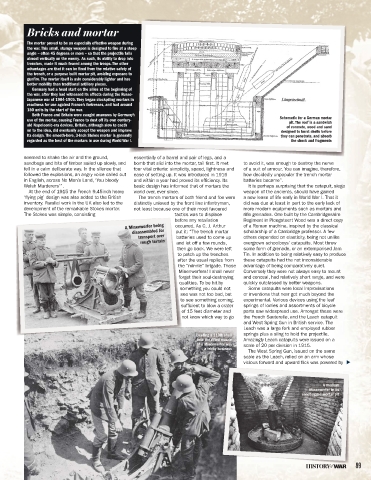
               use of the mortar, causing France to dust off its own century-                           Schematic for a German mortar
                                                                                                           pit. The roof is a sandwich
               old Napoleonic-era devices. Britain, although slow to cacth                                of concrete, wood and sand
               on to the idea,  did eventually accept the weapon and improve                            designed to burst shells before
               on to the idea, did eventually accept the weapon and improve
               its design. The smooth-bore, 3-inch Stokes mortar is generally
               its design.   The smooth-bore,  3-inch Stok es mor tar is g ener ally                    they can penetrate, and absorb
                g
                                  tars in use during
                 arded as the best of the mor
                                                 ar I.
                                              or
                                                W
                                               ld
                                             W
               regarded as the best of the mortars in use during World War I.                               the shock and fragments
               re
              seemed to shake the air and the ground,   essentially of a barrel and pair of legs, and a
              sandbags and bits of timber sailed up slowly, and   bomb that slid into the mortar, tail first. It met   to avoid it, was enough to destroy the nerve
              fell in a calm deliberate way. In the silence that   four vital criteria: simplicity, speed, lightness and   of a suit of armour. You can imagine, therefore,
              followed the explosions, an angry voice called out   ease of setting up. It was introduced in 1916   how decidedly unpopular the trench mortar
              in English, across No Man’s Land, ‘You bloody   and within a year had proved its efficiency. Its   batteries became”.
              Welsh Murderers’”.                    basic design has informed that of mortars the   It is perhaps surprising that the catapult, siege
               At the end of 1915 the French 9.45inch heavy   world over, ever since.      weapon of the ancients, should have gained
              ‘flying pig’ design was also added to the British   The trench mortars of both friend and foe were   a new lease of life early in World War I. That it
              inventory. Parallel work in the UK also led to the   distinctly unloved by the front line infantryman,   did was due at least in part to the early lack of
              development of the remarkable Stokes mortar.   not least because one of their most favoured   more modern equipments such as mortars and
              The Stokes was simple, consisting                    tactics was to displace   rifle grenades. One built by the Cambridgeshire
                                                                   before any retaliation   Regiment in Ploegsteert Wood was a direct copy
                                                 A Minenwerfer being   occurred. As C. J. Arthur   of a Roman machine, inspired by the classical
                                                    disassembled for   put it: “The trench mortar   scholarship of a Cambridge professor. A few
                                                      transport over   batteries used to come up   others depended on elasticity, being not unlike
                                                       rough terrain   and let off a few rounds,   overgrown schoolboys’ catapults. Most threw
                                                                    then go back. We were left   some form of grenade, or an extemporised Jam
                                                                    to patch up the trenches   Tin. In addition to being relatively easy to produce
                                                                    after the usual replies from   these catapults had the not inconsiderable
                                                                    the “minnie” brigade. Those   advantage of being comparatively quiet.
                                                                    Minenwerfers! I shall never   Conversely they were not always easy to mount
                                                                    forget their soul-destroying   and conceal, had relatively short range, and were
                                                                    qualities. To be hit by   quickly outclassed by better weapons.
                                                                     something you could not   Some catapults were local improvisations
                                                                     see was not too bad, but   or inventions that nevr got much beyond the
                                                                     to see something coming,   experimental. Various devices using the leaf
                                                                     sufficient to blow a crater   springs of lorries and assortments of bicycle
                                                                     of 15 feet diameter and   parts saw widespread use. Amongst these were
                                                                     not know which way to go   the French Sauterelle, and the Leach catapult
                                                                                           and West Spring Gun in British service. The
                                                                                           Leach was a large fork and employed rubber
                                                                          Loading a 110lb shell   springs plus a sling to hold the projectile.
                                                                           into the rifled muzzle   Amazingly Leach catapults were issued on a
                                                                          of a Minenwerfer was   scale of 20 per division in 1915.
                                                                             a tricky business  The West Spring Gun, issued on the same
                                                                                           scale as the Leach, relied on an arm whose
                                                                                           vicious forward and upward flick was powered by


                                                                                                                       A medium
                                                                                                                  Minenwerfer in its
                                                                                                               sandbagged mortar pit


                                                                                                                 HISTORY  WAR    89
                                                                                                                         of

