


Page 161 - Complete Birds of Britain and Europe (DK - RSPB)
P. 161
RAILS, CRAKES,AND COOTS
       Order Gruiformes       Family Rallidae        Species Fulica atra
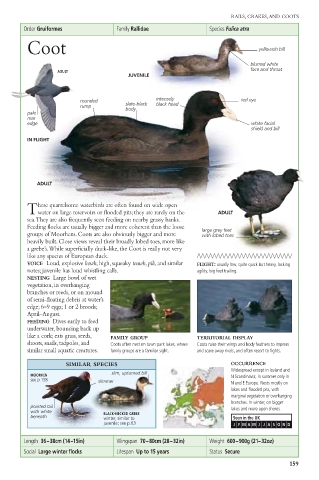
        Coot                                                     yellowish bill


                                                               blurred white
                                                               face and throat
               ADULT
                                 JUVENILE
                     rounded            intensely            red eye
                     rump       slate-black  black head
                                body
        pale
        rear
        edge                                                   white facial
                                                               shield and bill
        IN FLIGHT


          ADULT

          hese quarrelsome waterbirds are often found on wide open
        Twater on large reservoirs or flooded pits; they are rarely on the  ADULT
        sea.They are also frequently seen feeding on nearby grassy banks.
        Feeding flocks are usually bigger and more coherent than the loose  large grey feet
        groups of Moorhens. Coots are also obviously bigger and more  with lobed toes
        heavily built. Close views reveal their broadly lobed toes, more like
        a grebe’s.While superficially duck-like, the Coot is really not very
        like any species of European duck.
        VOICE Loud, explosive kowk, high, squeaky teuwk, pik, and similar  FLIGHT: usually low, quite quick but heavy, lacking
        notes; juvenile has loud whistling calls.  agility; big feet trailing.
        NESTING Large bowl of wet
        vegetation, in overhanging
        branches or reeds, or on mound
        of semi-floating debris at water’s
        edge; 6–9 eggs; 1 or 2 broods;
        April–August.
        FEEDING Dives easily to feed
        underwater, bouncing back up
        like a cork; eats grass, seeds,  FAMILY GROUP  TERRITORIAL DISPLAY
        shoots, snails, tadpoles, and  Coots often nest on town park lakes, where  Coots raise their wings and body feathers to impress
        similar small aquatic creatures.  family groups are a familiar sight.  and scare away rivals, and often resort to fights.
                 SIMILAR SPECIES                          OCCURRENCE
                                                          Widespread except in Iceland and
                             slim, upturned bill
         MOORHEN                                          N Scandinavia; in summer only in
         see p.158       slimmer                          N and E Europe. Nests mostly on
                                                          lakes and flooded pits, with
                                                          marginal vegetation or overhanging
                                                          branches. In winter, on bigger
         pointed tail                                     lakes and more open shores.
         with white        BLACK-NECKED GREBE
         beneath           winter, similar to              Seen in the UK
                           juvenile; see p.63              J  F  M  A  M  JJ A S O  N  D
       Length  36–38cm (14–15in)  Wingspan  70–80cm (28–32in)  Weight  600–900g (21–32oz)
       Social  Large winter flocks  Lifespan  Up to 15 years  Status  Secure
                                                                         159

