


Page 160 - Complete Birds of Britain and Europe (DK - RSPB)
P. 160
RAILS, CRAKES,AND COOTS
       Order Gruiformes       Family Rallidae        Species Gallinula chloropus
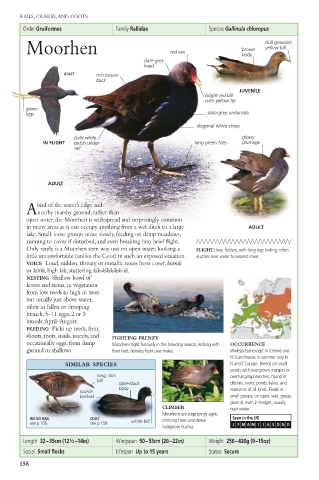
        Moorhen                                              brown  dull greenish
                                                                   yellow bill
                                           red eye
                                                             body
                                     slate-grey
                                     head
                 ADULT   rich brown
                         back
                                                            JUVENILE
                                                    bright red bill
                                                    with yellow tip
       green
       legs                                          slate-grey underside
                                                  diagonal white stripe
                   bold white                                glossy
            IN FLIGHT  patch under               long green toes  plumage
                   tail


             ADULT

          bird of the water’s edge and
        Anearby marshy ground, rather than
        open water, the Moorhen is widespread and surprisingly common
        in many areas as it can occupy anything from a wet ditch to a large  ADULT
        lake. Small, loose groups move slowly, feeding on damp meadows,
        running to cover if disturbed, and even breaking into brief flight.
        Only rarely is a Moorhen seen way out on open water, looking a  FLIGHT: low, fluttery, with long legs trailing; often
        little uncomfortable (unlike the Coot) in such an exposed situation.  scutters over water to nearest cover.
        VOICE Loud, sudden, throaty or metallic notes from cover, kurruk
        or kittik, high kik, stuttering kik-kikikikik-ik.
        NESTING Shallow bowl of
        leaves and stems, in vegetation
        from low reeds to high in trees
        but usually just above water,
        often in fallen or drooping
        branch; 5–11 eggs; 2 or 3
        broods;April–August.
        FEEDING Picks up seeds, fruit,
        shoots, roots, snails, insects, and  FIGHTING FRENZY
        occasionally eggs, from damp  Moorhens fight furiously in the breeding season, kicking with  OCCURRENCE
        ground or shallows.  their feet; females fight over males.  Widespread except in Iceland and
                                                          N Scandinavia; in summer only in
                 SIMILAR SPECIES                          N and E Europe. Breeds on small
                                                          ponds with overgrown margins or
                         long, slim                       overhanging branches; found in
                         bill
                               slate-black                ditches, rivers, ponds, lakes, and
                               body                       reservoirs of all kinds. Feeds in
                     round-
                     backed                               small groups, on open, wet, grassy
                                                          ground, even in hedges, usually
                                         CLIMBER          near water.
                                         Moorhens are surprisingly agile,
        WATER RAIL     COOT              climbing trees and dense  Seen in the UK
        see p.156      see p.159  white bill               J  F  M  A  M  JJ A S O  N  D
                                         hedgerow bushes.
       Length  32–35cm (12 1 ⁄2 –14in)  Wingspan  50–55cm (20–22in)  Weight  250–420g (9–15oz)
       Social  Small flocks   Lifespan  Up to 15 years  Status  Secure
      158

