


Page 166 - Complete Birds of Britain and Europe (DK - RSPB)
P. 166
WADERS
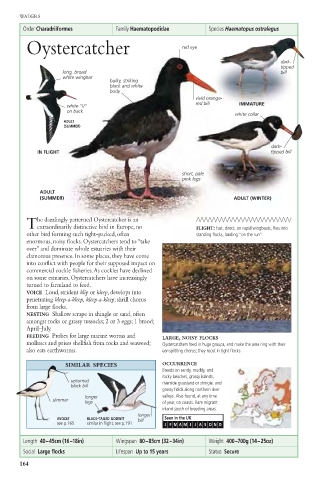
       Order Charadriiformes  Family Haematopodidae  Species Haematopus ostralegus
        Oystercatcher                         red eye

                                                                       dark-
                                                                       tipped
                 long, broad                                           bill
                 white wingbar
                            bulky, striking
                            black and white
                            body
                                                  vivid orange-
                                                  red bill  IMMATURE
                  white “V”
                  on back
                                                           white collar
                 ADULT
                 (SUMMER)
                                                                    dark-
          IN FLIGHT                                                 tipped bill

                                              short, pale
                                              pink legs
           ADULT
           (SUMMER)                                        ADULT (WINTER)


          he dazzlingly patterned Oystercatcher is an
        Textraordinarily distinctive bird in Europe, no  FLIGHT: fast, direct, on rapid wingbeats; flies into
        other bird forming such tight-packed, often  standing flocks, landing “on the run”.
        enormous, noisy flocks. Oystercatchers tend to “take
        over” and dominate whole estuaries with their
        clamorous presence. In some places, they have come
        into conflict with people for their supposed impact on
        commercial cockle fisheries.As cockles have declined
        on some estuaries, Oystercatchers have increasingly
        turned to farmland to feed.
        VOICE Loud, strident klip or kleep, develops into
        penetrating kleep-a-kleep, kleep-a-kleep; shrill chorus
        from large flocks.
        NESTING Shallow scrape in shingle or sand, often
        amongst rocks or grassy tussocks; 2 or 3 eggs; 1 brood;
        April–July.
        FEEDING Probes for large marine worms and  LARGE, NOISY FLOCKS
        molluscs and prises shellfish from rocks and seaweed;  Oystercatchers feed in huge groups, and make the area ring with their
        also eats earthworms.            ear-splitting chorus; they roost in tight flocks.
                 SIMILAR SPECIES         OCCURRENCE
                                         Breeds on sandy, muddy, and
                                         rocky beaches, grassy islands,
                   upturned              riverside grassland or shingle, and
                   black bill
                                         grassy fields along northern river
                      longer             valleys. Also found, at any time
              slimmer  legs              of year, on coasts. Rare migrant
                                         inland south of breeding areas.
                                   longer
               AVOCET  BLACK-TAILED GODWIT  bill  Seen in the UK
               see p.165  similar in flight; see p.191  J  F  M  A  M  JJ A S O  N  D
       Length  40–45cm (16–18in)  Wingspan  80–85cm (32–34in)  Weight  400–700g (14–25oz)
       Social  Large flocks   Lifespan  Up to 15 years  Status  Secure
      164

