


Page 163 - Complete Birds of Britain and Europe (DK - RSPB)
P. 163
CRANES AND BUSTARDS
       Order Gruiformes       Family Otididae        Species Otis tarda
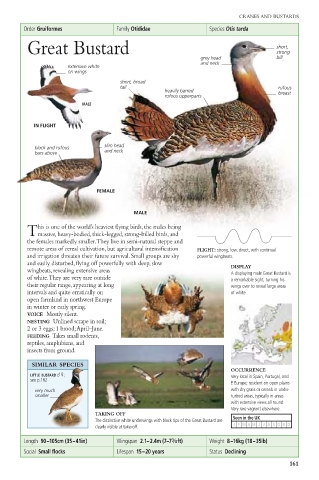
        Great Bustard                                                 short,
                                                                      strong
                                                   grey head          bill
                                                   and neck
                  extensive white
                  on wings
                               short, broad
                               tail                                   rufous
                                          heavily barred              breast
                                          rufous upperparts
                     MALE
         IN FLIGHT

                           slim head
          black and rufous  and neck
          bars above


                         FEMALE


                                  MALE
          his is one of the world’s heaviest flying birds, the males being
        Tmassive, heavy-bodied, thick-legged, strong-billed birds, and
        the females markedly smaller.They live in semi-natural steppe and
        remote areas of cereal cultivation, but agricultural intensification  FLIGHT: strong, low, direct, with continual
        and irrigation threaten their future survival. Small groups are shy  powerful wingbeats.
        and easily disturbed, flying off powerfully with deep, slow  DISPLAY
        wingbeats, revealing extensive areas              A displaying male Great Bustard is
        of white.They are very rare outside               a remarkable sight, turning his
        their regular range, appearing at long            wings over to reveal large areas
        intervals and quite erratically on                of white.
        open farmland in northwest Europe
        in winter or early spring.
        VOICE Mostly silent.
        NESTING Unlined scrape in soil;
        2 or 3 eggs; 1 brood;April–June.
        FEEDING Takes small rodents,
        reptiles, amphibians, and
        insects from ground.
         SIMILAR SPECIES
                                                          OCCURRENCE
         LITTLE BUSTARD 32;                               Very local in Spain, Portugal, and
         see p.162
                                                          E Europe; resident on open plains
          very much                                       with dry grass or cereals in undis-
          smaller                                         turbed areas, typically in areas
                                                          with extensive views all round.
                                                          Very rare vagrant elsewhere.
                         TAKING OFF
                         The distinctive white underwings with black tips of the Great Bustard are  Seen in the UK
                         clearly visible at take-off.      JF M A  M J  JA S ON D
       Length  90–105cm (35–41in)  Wingspan  2.1–2.4m (7–7 3 ⁄4ft)  Weight  8–16kg (18–35lb)
       Social  Small flocks   Lifespan  15–20 years  Status  Declining
                                                                         161

